
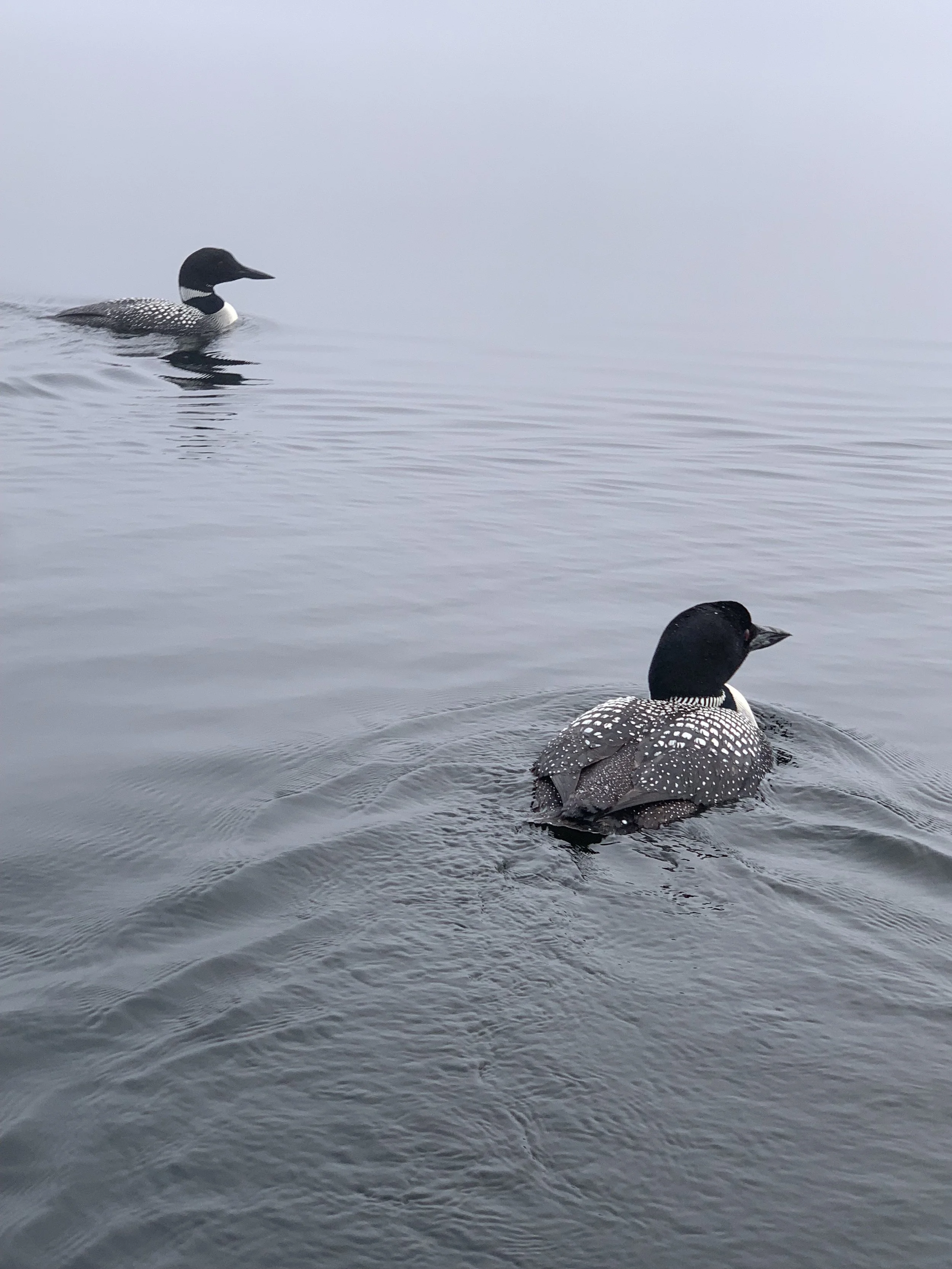
Some loons I encountered on one morning, Christine Lake, north of the Ammonoosuc River, Coos County NH
There are sounds in the wild that seem to come from a world both far away and familiar, where something in the landscape stirs something alive within us. The call of Loon rising over a dark lake is such a sound. Ancient and haunting, there is grief in that call. Across several Indigenous traditions of North America, Loon emerges as a mythic figure of grief and transformation. She is a maternal keeper of what is too painful to see, a witness to both the wounds we suffer and the wounds we inflict. She does not make tragedy disappear; she enters its darkness with us. It is as though, through meeting Loon Woman within the storied world, we come to know something of this creature called grief.
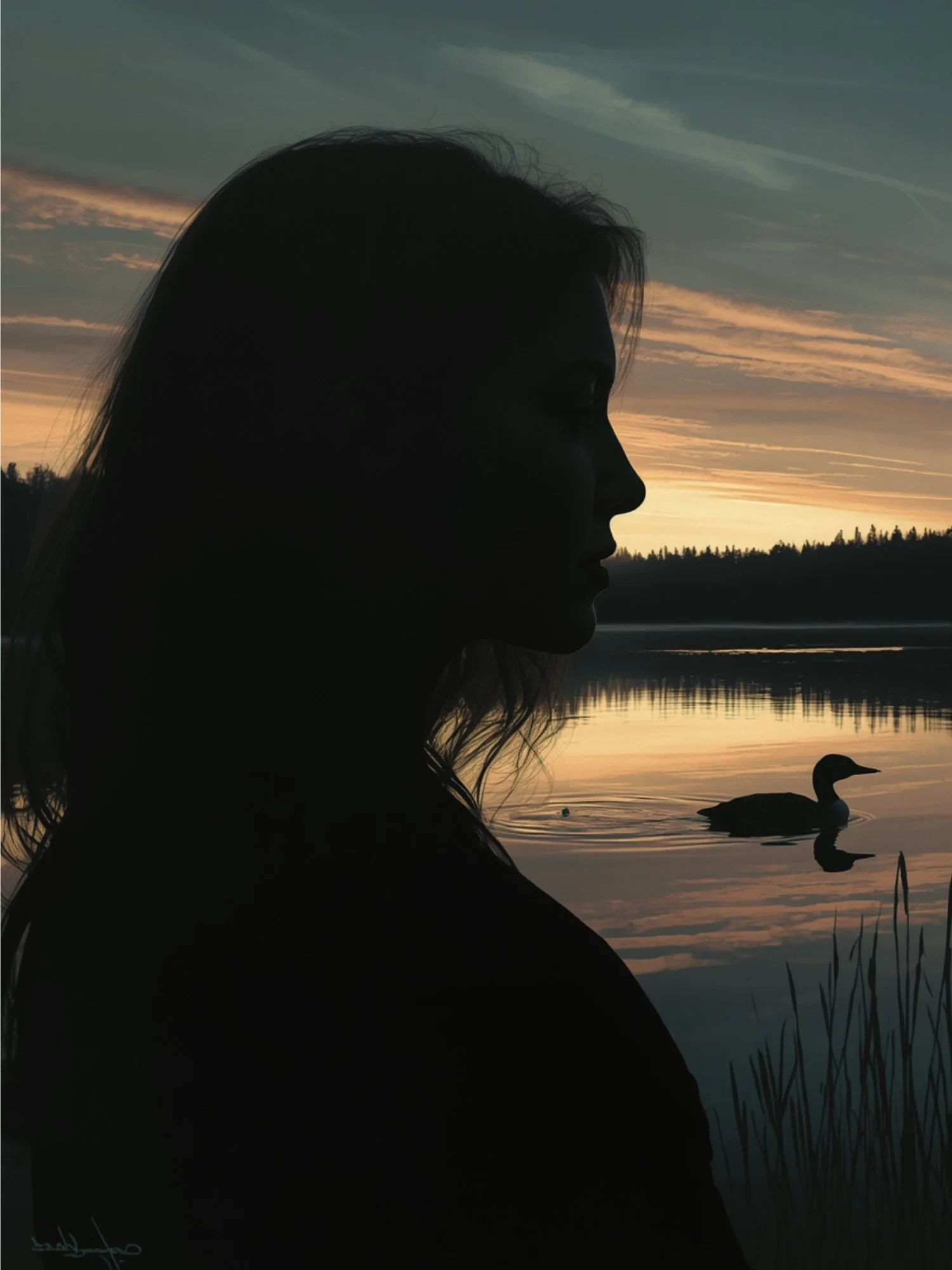
Among Inuit communities in Alaska, Greenland, and Canada, Loon enters into folklore and legend as a surrogate mother to an unmothered hero. In two versions of the same tale, a young boy’s extraordinary gift for hunting becomes the envy of his stepmother. She comes to resent the place he has earned as his family’s provider and uses her dark magic cruelly to blind him, destroying the very gift that allowed him to feed and protect them. He is left helpless and dependent, and, as if this loss were not enough, she withholds food from him, and he begins to starve. When a polar bear unexpectedly attacks their igloo trapping the entire family in a desperate fight for survival, the boy once again rises as the family’s protector and defender. Though blind, the boy draws on his courage and skill with the bow, and guided by his sister toward the polar bear succeeds in killing it saving his family, yet his blindness keeps him from knowing his success. The tale darkens even further still when his stepmother tells him he has missed the bear, and keeps the truth—and the meat—from him. Eventually, abandoned, starving and alone, the boy wanders far from home until he reaches the edge of a lake. There Loon is waiting for him. She shelters him beneath her wing and takes him into her care. When the time comes, he climbs onto her back, and she bears him down into the depths, into her own hidden world beneath the lake. When they surface, his sight has slightly returned. The second time, Loon carries him deeper still, she keeps him close, holding him in the darkness and when he resurfaces, more of the world comes into view. Then Loon carries him down a third time, she takes him into the deepest darkness while something inside him is remade. When at last she carries him back into the light, his sight is restored. Returning to his home, he sees the meat of the slain polar bear hanging to dry and, with his restored vision, finally perceives the true, cruel nature of his stepmother.
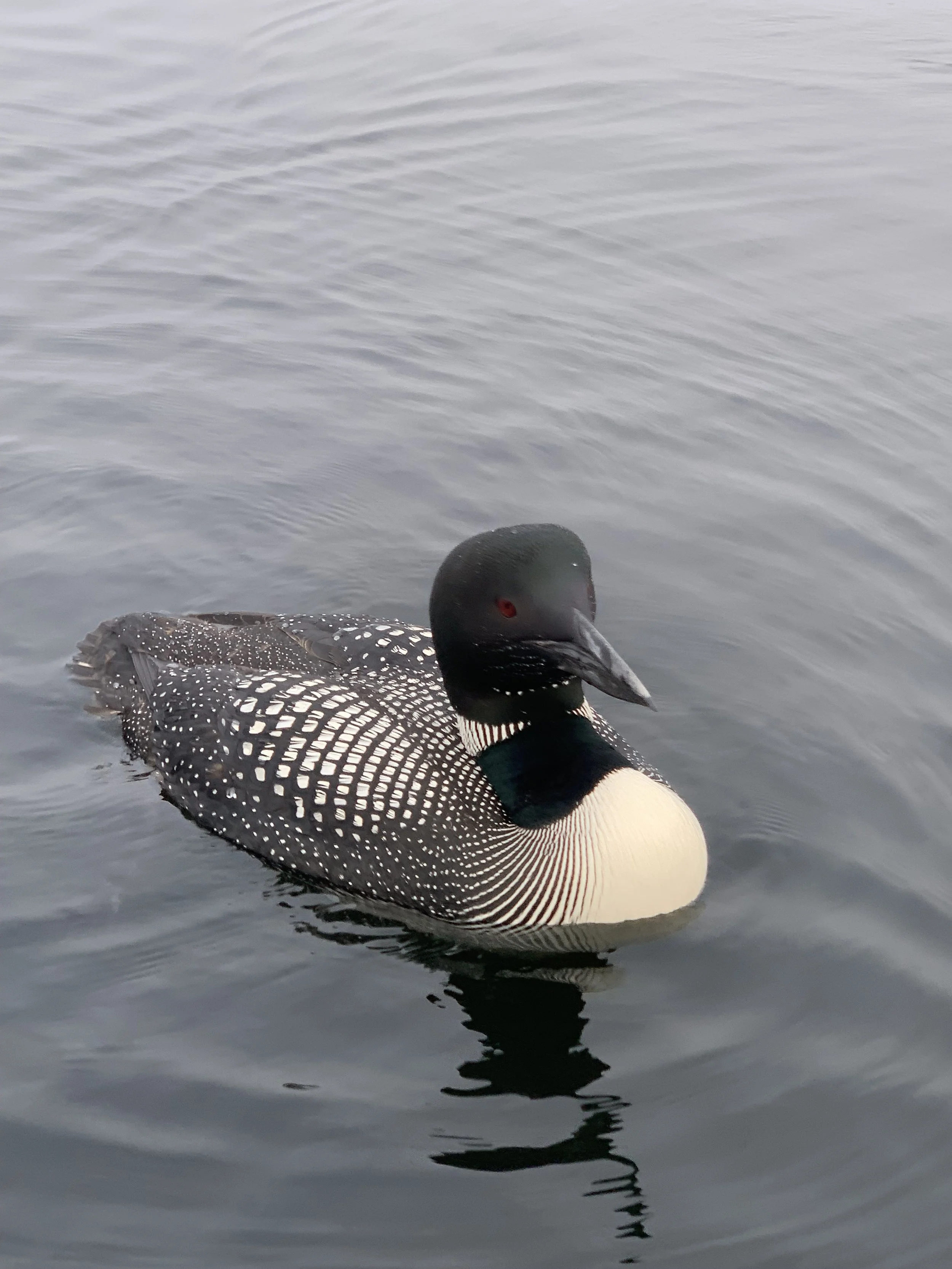
As a linocut artist, I find loons wonderfully suited to the medium — their striking black and white coloring and white speckles, patterns and stripes seem to be made just for block printing design
Perhaps most profoundly, this tale offers us a frame through which the voice of Loon’s resonance with grief becomes more palpable. Her haunting call gives the stories a sound that carries beyond the telling, perhaps even calling forth a grief we did not know we carried. In the boy’s case, Loon tethers the child to the work of seeing a painful truth he could not bring himself to see—not merely restoring his sight, but giving him the courage to remain with what is tragic, to face it unmistakably, and to feel its full weight. Similar to how Loon’s haunting call can draw out a sorrow or sadness we did not know was there until we heard it.
Still something else begins to emerge: when the boy’s human mother can no longer be a source of care and instead becomes a source of harm, he must find another form of kinship. Loon rises to meet him. What follows is a profound shift from human kin to creaturely kin: Loon becomes his mother in the wild, the sole witness to his suffering and the being whose tenderness, protection, and presence make survival possible. Cradled within the wings of Loon, the boy discovers that kinship need not end at the boundary of the human; the wild can hold him, too. It is a Loon (not a human) who accompanies the boy in his descent into his own pain and sorrow over his abandonment, and Loon again serves as a compassionate witness to the unbearable loss of his primary human attachment. There in the depths, in Loon’s underwater world, is where he transforms. When they resurface and return to the human world, his physical sight is restored, but the deeper transformation has already occurred. Having been held and witnessed by a creaturely mother, spent time in her world, he has acquired the capacity to remain with the pain of a truth he was once unable—or unwilling—to behold. What these stories reveal, then, is a tender and difficult truth: that the wild can sometimes witness and hold us more fully than our human kin, revealing a shared emotional world in which the boundary between human and creaturely life is far less rigid than we might imagine. What begins as a relationship within the story becomes a yearning for communion beyond it, as the stories reveal our real human limitations and how deeply we need the wild.
When grief becomes creaturely, feathered and embodied, alive to the waters, swimming and feeding in the depths, grief’s descent need not be understood as a failing, a weakness, or a path we must hurry to overcome but rather part of this creature’s nature, how she naturally lives. Loon’s intimate belonging to an underwater world and her rising again into surface and for flight give physical form to grief’s own journey—from depth to integration, from submergence to emergence. In the storied world of this age-old tale, we come to see when the human reaches the edge of what he can hold, he is drawn toward the wild—as toward an ancient mother, older and larger than himself, who can receive what he cannot carry. Every boundary begins to grow porous, until beneath them all we glimpse the oldest bond of all: the umbilical tether between mother and child, between ourselves and the mothering wild.
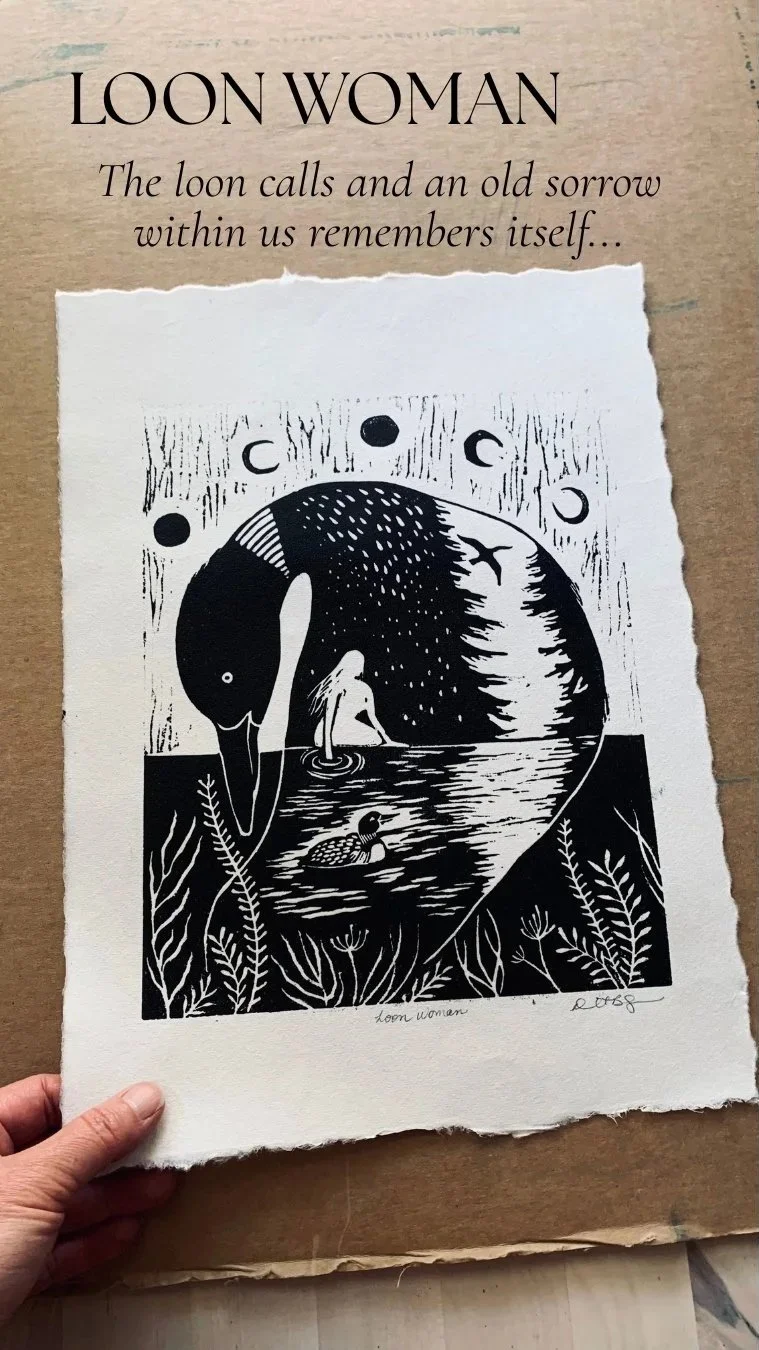
A handcrafted linocut print inspired by Loon Woman available in my shops
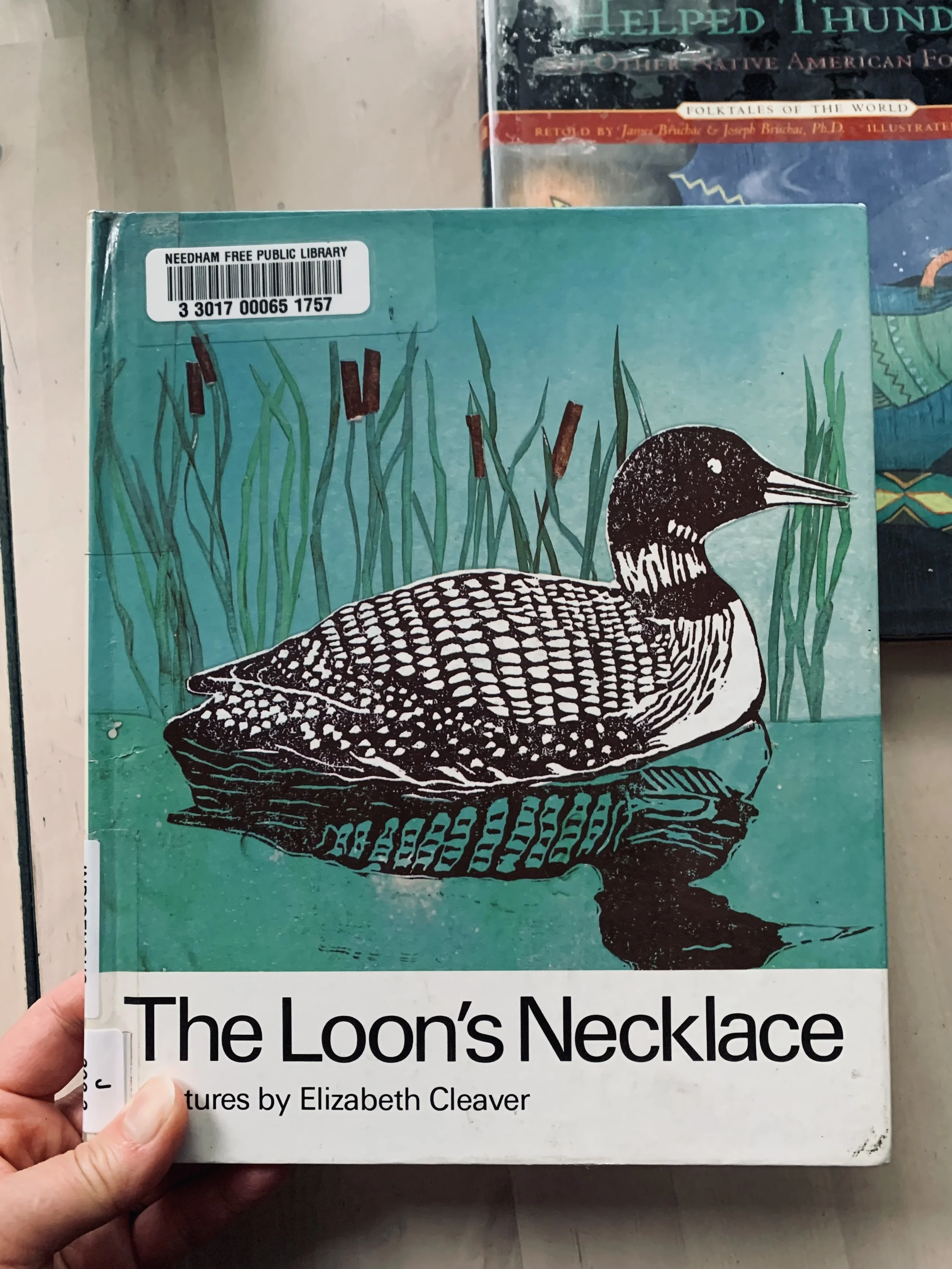
Among the Tsimshian of the Pacific Northwest of Canada, Loon enters story once more as a maternal and healing keeper of grief, restoring the sight of a character - this time an elderly man - whose blindness has become both his wound and his undoing. As in the tale before, this hero had once been an excellent hunter and provider for his family, but now, unable to see, he feels helpless and grieves the tragedy that his family is left with less food. His son accompanies him to the edge of a lake, where they encounter a bear. Once again, though the hero is blind, his son’s help in guiding the man’s bow in the bear’s direction, he releases his arrow, and kills the bear. But the bear meat does not reach the old man’s mouth. A cruel hag takes its meat, placing pieces into the son’s hands while denying them to the elder man teaching the boy a cruel lesson: that a father who can no longer see, hunt, or provide is no longer worthy of care. The boy is made to carry this cruelty in silence, warned that if he speaks, the hag will beat him. The abandoned old man chooses to separate himself from his family, telling is son to return home as he wanders alone by the lake. There, like the previous tale, Loon is once again waiting for him. Loon takes him under her wing, and when he is ready, she carries the wounded hero on her back beneath the surface into the depths of the lake, away from his world of tragedy and into the darkness where he can be remade. Three times they descend, and each time through her witnessing and holding, he recovers his sight until the third time when they resurface, his vision is restored. With gratitude to Loon, he gifts her his prized necklace made of white shells, and this is how Loon finds herself with those many white speckles on her back and wings. The old man returns home joyfully to his family, but that night the cruel hag knocks on the door and pleads to be let in. This time, contrary to the kindness, the patience and generosity they offered her before, the family does not answer, they all have their sight restored. The next day, they journey far away carrying with them the knowledge that sight can reveal not only what is before the eyes, but what cruelty has tried to keep hidden.
Here, as in the tale before it, the hero is abandoned—but this time, the abandonment comes from within. Having lost his sight, he comes to believe that he is no longer worthy, and chooses to separate himself from his family. Loon once again meets the hero in his suffering and accompanies him into the depths, where he is finally able to grieve what he has lost. When she brings him back into the light, his sight is restored, but so too is something within him: the courage to behold the hag’s cruelty and to recognize a similar voice within himself that had once kept him from feeling worthy of having a place in the home among his human kin. What is restored is not only the man’s ability to see, but his capacity to see himself—to recognize that he is worthy of being held, protected, and loved. The white markings on Loon’s body become a living trace of the bond between human and bird, and grief’s oldest mystery: that sometimes we must descend into the depths, into the great body of the living world, to find our way back to ourselves and those we love. The loon story reveals the limits of human seeing, and how the wild can become a larger witness, holding us in its gaze until we can finally see ourselves. Through her call and her white necklace, we are reminded of an ancient courtship between human and wild—a meeting place where the boundaries between worlds soften, and where each becomes woven into the life of the other. This is the marriage-place of worlds, where human and loon begin to blur, until the wild emerges as mother, gathering back into belonging what the human world has broken.
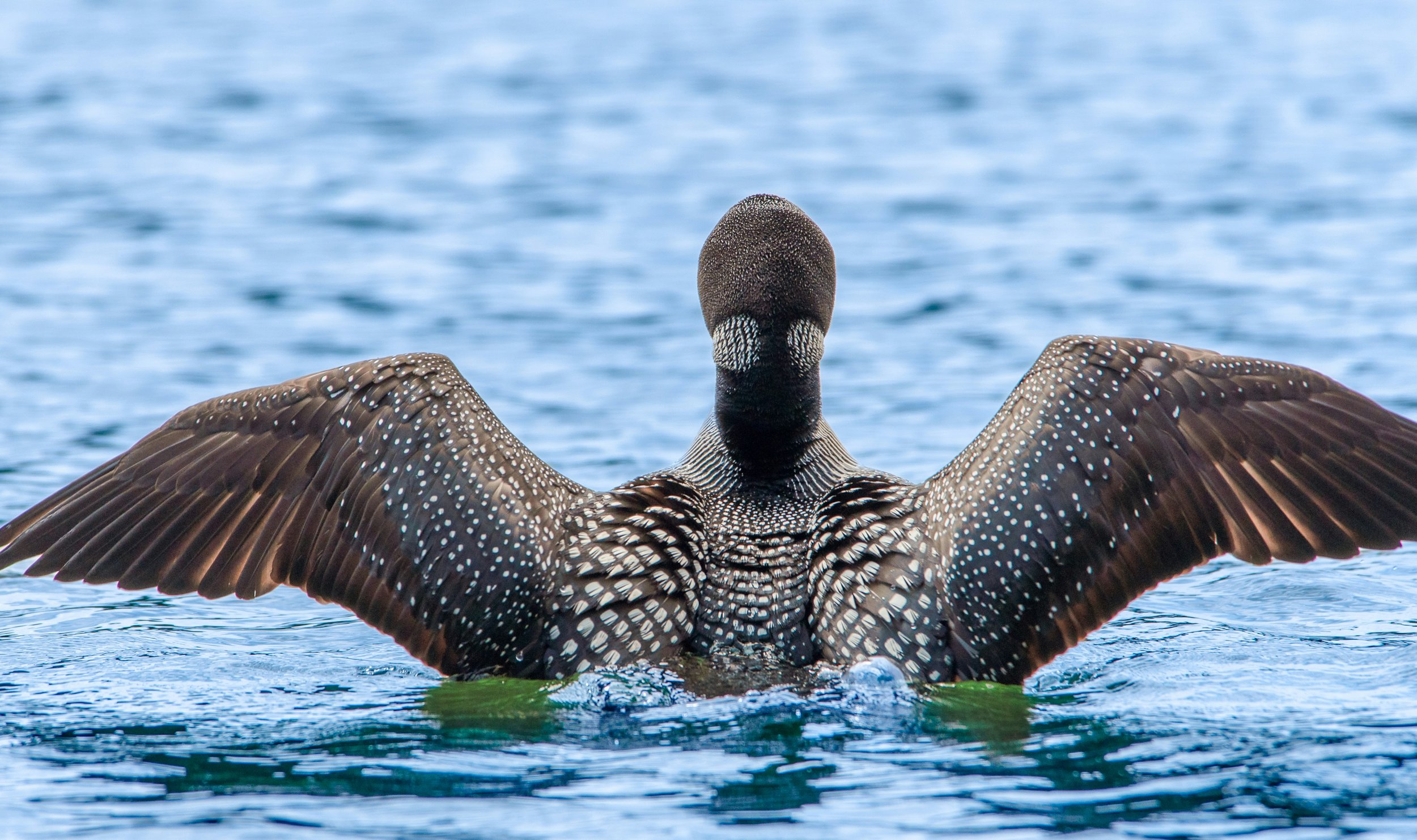
I love how the little white spots on a loons back echo the stars above. At night in loon country of the lakes of the northeastern woodlands, there comes to be three skies: the stars above, the stars reflected upon the surface of the lake, and the stars scattered across the loon’s back. And the loon’s call is the thread that binds them all together — a kind of ancient song stitching sky to water, water to bird, and waking to dream. Photo Credit: Bill Chomik on Unsplash
Among the oral traditions of the Modoc, Yana, Shasta, Achomawi, Atsugewi, Maidu, Karok, and Wintu of Northern California, there is a haunting tale of Ishanihura, the Loon Woman. In the story, a beautiful young woman becomes consumed by a forbidden desire for her older brother, and from that desire unfolds a terrible chain of incest, murder, and grief, each tragedy giving rise to the next until the sacred bonds of kinship are shattered. In the end, she is transformed into Loon. Around her neck hangs a white necklace of skulls, each one belonging to a member of her family whose life she has wounded and taken, giving mythic meaning to the loon’s white markings. Here the heroine’s crime is woven into her own body, and she must carry the memory of the tragedy she was responsible for and the weight of its pain forever. The creature she becomes is both stunningly beautiful and also burdened, forever bearing the memory of the lives she destroyed and the grief that cannot be undone.
Here Loon is both the bearer of the wound and the one who remains to witness its sorrow. Loon, an aquatic creature who dives beneath the waters, brings to the surface what we cannot bear to hold ourselves: family secrets, darker impulses, and taboo desires made visible through the girl’s unfolding tragedy and her own transformation that follows. Loon Woman’s white necklace becomes a visible remembrance of the shadowed parts of human nature - yet her beauty speaks to something we don’t often associate with grief, though it belongs to its deepest mystery. Echoed in the stories that preceded this one, grief enlarges our sense of kinship and belonging to the earthly world, it deepens rather diminishes this mystery, it opens us up to the preciousness and impermanence of what we have, and deeply reveals the depths of our attachments. After descending into sorrow, we may rise again to the surface carrying beauty, meaning, and a life-giving force born of the depths themselves. Occupying both sides of the wound, Loon Woman reveals something of this strange creature called grief. Within the spell of the telling of these tales, grief emerges an earthly body that is dark feathered and speckled, beautiful and haunting, aquatic and aerial, floating between water and sky. Perhaps this is the ancient wisdom Loon Woman, the Grief Keeper, is inviting us to see: grief is a creature who lives between worlds without leaving either behind.
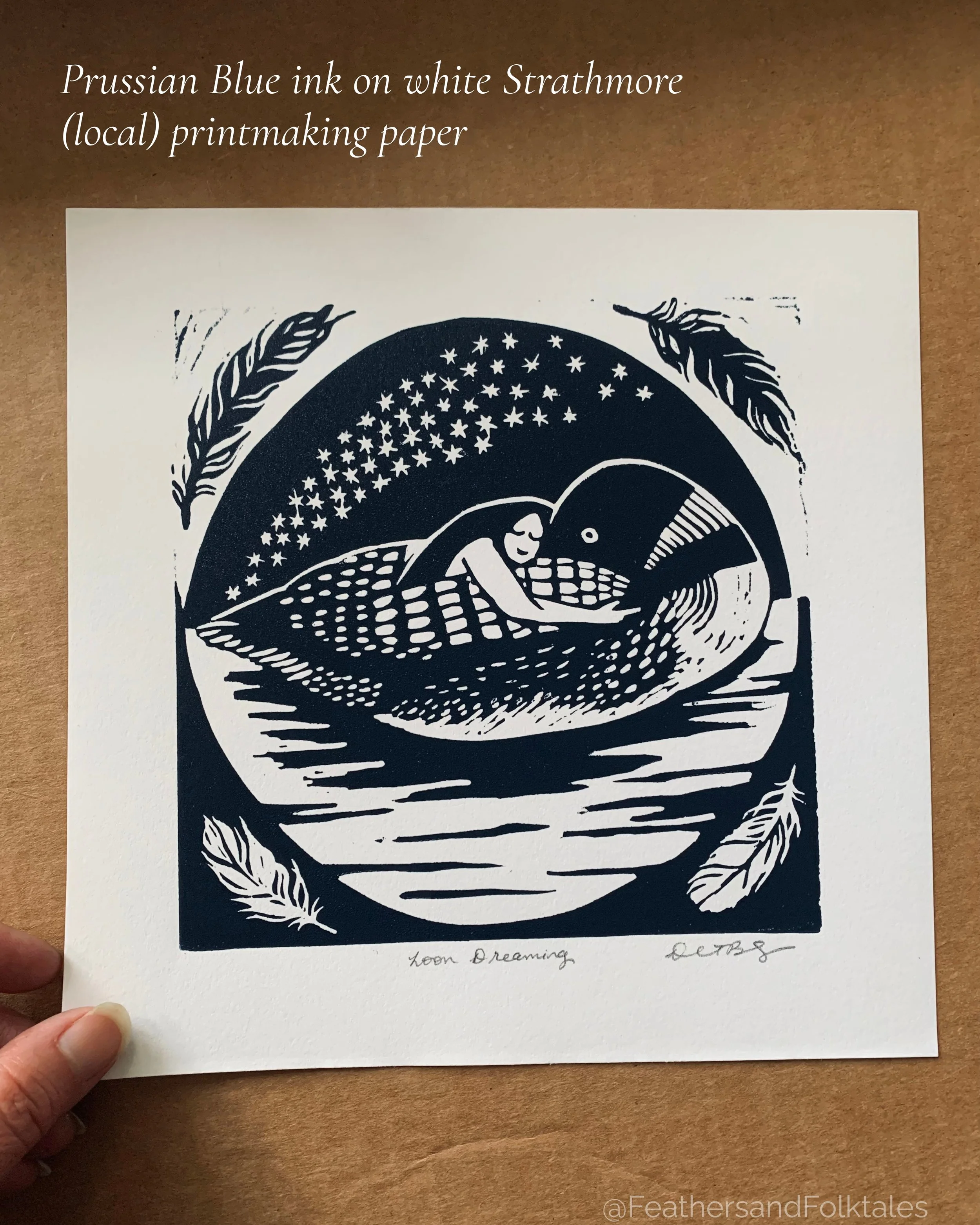
“Loon Dreaming” - a handcrafted linocut available in my shops!
In these age-old stories, where the natural world and the human heart are understood as part of the same living story, grief is given a creaturely body: feathered and wild, that dives beneath the water’s surface to feed. Loon Woman holds within her voice and body the wild’s map for the grief journey, we come to see the journey of descent and rising again not something unnatural or aberrant, but an ancient movement, wild and earthly, deeply woven into the living world. Both the depths and ascent of Loon’s movement, alongside her haunting cries, blur the boundary between the storied world and the world beyond, between human emotion and the more-than-human wild, between human kinship and wild kinship. Through Loon Woman, the wild translates herself into human story, so that an ancient knowing, older than language itself, may awaken once more inside us helping us to know better this creature called grief. Where science can place distance between the human and the wild, the mythic realm draws them into poetic entanglement. For a little while, in this marriage-place-of-worlds, Loon enters the human story and the human story begins to live in the creature and the distance between human and the living landscape dissolves. Perhaps the most poetic example of this entwinement is described by Richard Nelson, ethnobiologist, who lived among the Koyukon of northwestern Alaska. They believe that humans and animals once shared a common language in the old time, before the worlds were divided, when they could pass freely between one another’s worlds and bodies. When a revered Koyukon elder lay near death, an old woman sat on the shore of a lake and sang the spring songs. Two loons swam toward her and answered, their voices mingling with hers across the water. She told Nelson that loons will always answer human song—as if, beneath the boundary between forms of being, the old language were still alive. Here, as in each of these stories, Loon’s call becomes a relation rather than just a backdrop to our human drama, and we remember that even in grief we belong not above the living world, but next to her, tucked under the wing of a speckled mother bird.
End Note: What Loon also asks us to remember. . .
I approach these stories not to make sweeping claims about loons in Indigenous traditions, nor to present myself as an expert, but to listen carefully to their distinct stories and iterations, each rooted in particular ways of knowing and expressing what Loon means. What I offer here is simply what I have received from them—what they have opened in me, what they have taught me about grief, kinship, and our relationship with the more-than-human world—while honoring that their meanings extend far beyond my own understanding. And as I reflect on what Loon Woman carries about grief, it feels important to listen, too, for the grief held within this North American landscape, much of it submerged and unspoken, and to acknowledge that what needs to be grieved and remembered are not only these precious stories, but languages, lifeways, homelands, relationships, and lives.
References:
Bierhorst, John (1997). “The Blind Boy and the Loon”, in The Dancing Fox: Arctic Folktales. New York: William, Morrow & Company., pp. 125-131.
Bruchac, James., and Bruchac, Joseph (2008). “The Blind Boy and the Loon”, in The Girl Who Helped Thunder and Other Native American Folktales. New York: Sterling Publishing Co. pp.86-89.
Kroeber, Theodora. “Loon Woman”, in The Inland Whale: Nine Stories Retold from California Indian Legends. Bloomington: Indiana University Press, 1959. pp. 39-65
Nelson, Richard., in Abram, David. “Landscape of Language” The Spell of the Sensuous: Perception and Language in a More-Than-Human World. New York: Pantheon Books, 1996.
Toye, William (1977). The Loon’s Necklace. Oxford University Press,
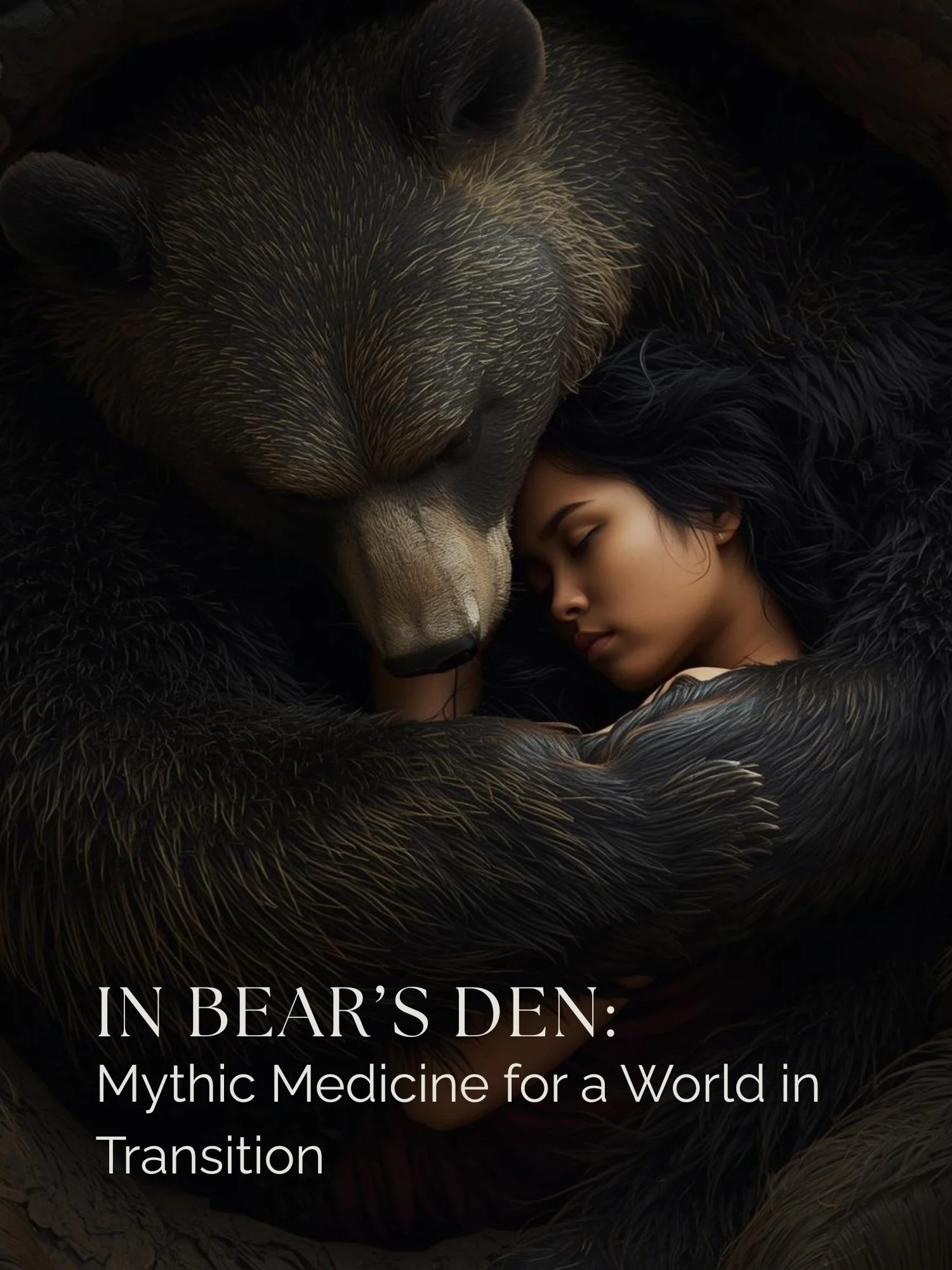

Since the first dreaming of the world, there have always been stories in which the earth found a body, a voice, and a face through which to enter our human world, dreaming herself into human form. Creaturely heroines are not merely figures who move through the landscape but an expression of the courtship of human imagination and the earth, the way the land births herself into being in the storied world, this marriage-place of worlds. Through the creaturely heroine’s ecstasies and griefs, her shapeshifting and return, we are welcomed into an imaginal realm beyond the limited scope of our human experience, and we begin to see see the world through the wild’s eyes. She is the earth’s emissary, the way the wild enters into our world embodied, drawing us into an emotional kinship felt before it is understood.