
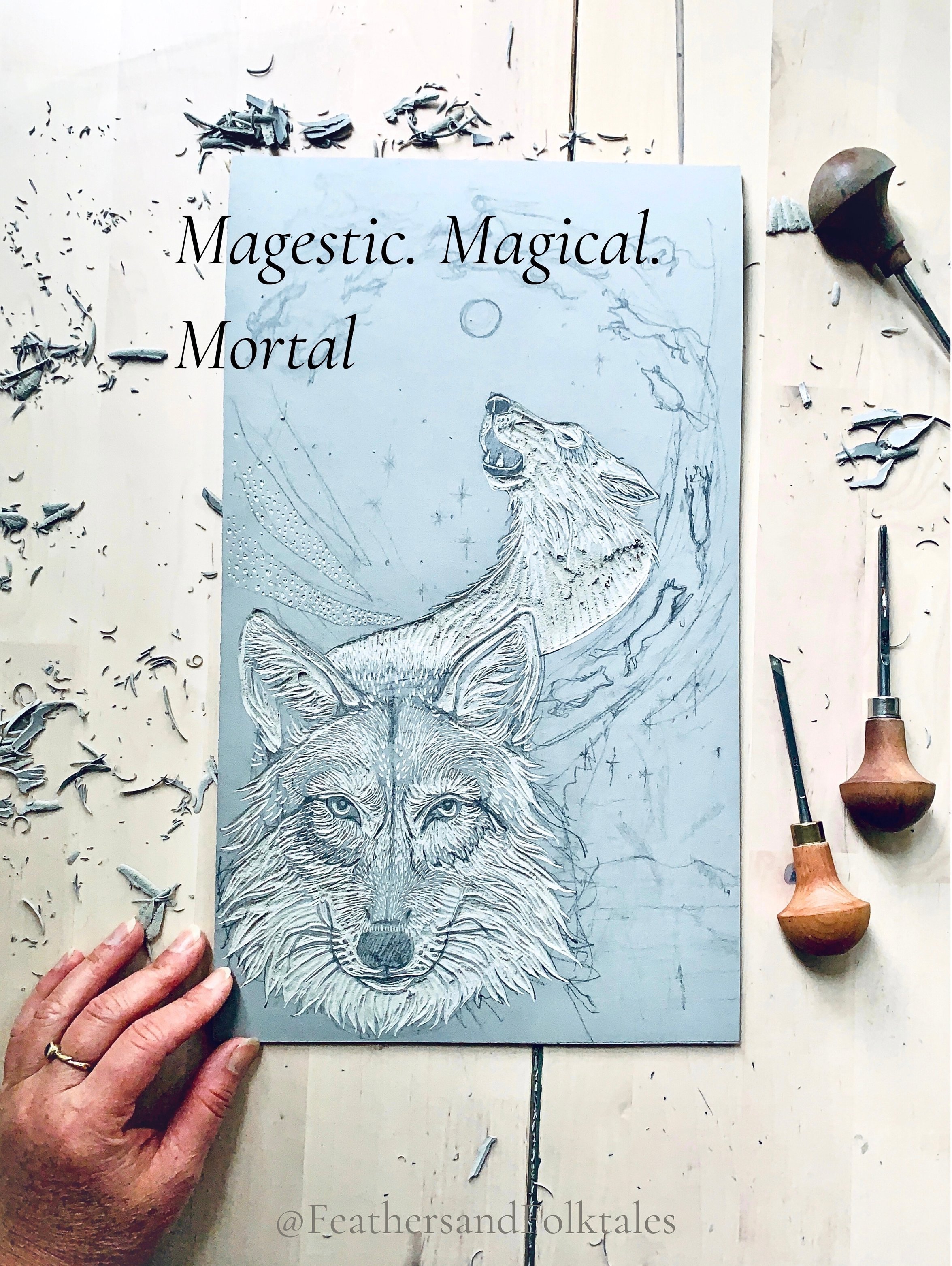
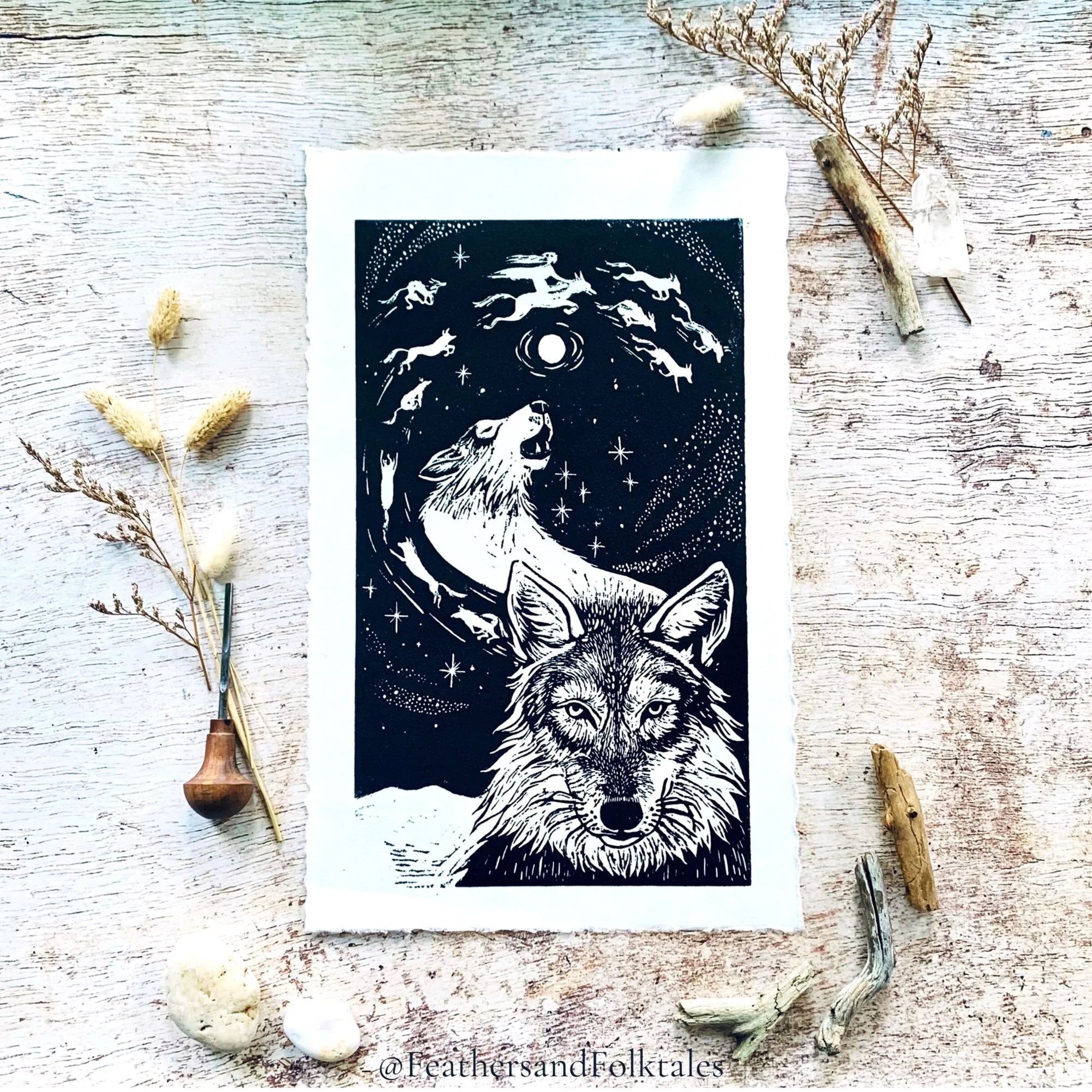
Wolf is interwoven into the mythic imagination of our human story since deep time, not only as a wild animal we have known as close kin, but more recently as a creature we have exiled, cast into shadow, sacrificed and erased from the landscapes of both earth and memory. One such myth that captures this is La Loba—Wolf Woman also known as Bone Woman — an ancient creaturely heroine rooted in the Desert Southwest, in which an old woman wanders the deep canyons and arroyos of the desert, gathering the scattered bones of Wolf. The heart of the tale is alchemical and generative. As she sings and begins the patient work of piecing the bones back together, flesh gathers, tendons form, bristly fur lifts along the neck, the narrow muzzle twitches, long sinewed limbs quiver and Wolf awakens, alive once more. Before the old woman can catch her breath, Wolf has already found her way to the horizon, her sleek form silhouetted against the sunrise, and all that remains is a distant howl carrying the voice of both Wolf and woman alike—a sound woven into the world's eternal turning. La Loba is not simply a story of death and return. It is a story about what happens when something living has been torn apart and buried and the sacred labor required to gather its bones and breathe animacy back into it again. What might this ancient borderland story about Wolf, and the sacred labor required to bring Wolf back, have to say about the world we find ourselves living in today? For it is often when the world stands at a threshold that the questions living inside our oldest stories return.
The Desert Southwest is a landscape that has recently begun to stir again within our cultural imagination. Public conversations surrounding the U.S.–Mexico border invite us to reflect on whether borders protect or harm, stirring deeper questions about security, sovereignty, immigration and national identity. What might happen if we welcomed the ancient voice of La Loba into the circle of this contemporary conversation? What might shift if Bone Woman was allowed to sit among us as we wrestle with these modern questions? Perhaps her presence could widen the frame of our understanding, and help us to glimpse the larger pattern in which these tensions are held — the pattern of burial, of gathering, singing of loss, of awakening of the whole and the return of the howl.
Though this story is old, it whispers truths that feel uncannily close to the world we are living inside now: when we divide what was once whole, something living is deeply wounded and buried alive beneath the earth. The roughly 700‑mile steel wall that serves as an international border between the U.S. and Mexico divides a vast breathtaking landscape composed of the Sonoran and Chihuahuan deserts of rust-red earth and sage-green scrub, wind-swept arroyo corridors etched by time, sun-gold grasslands, deep canyons and rugged mountain ranges that rise like ancient spines of the earth. It is a landscape that has captured the imagination of storytellers, poets, artists, visitors and Indigenous peoples alike. The Diné creation story describes the landscape as a luminous “Glittering World” - the Fourth World in which they now live. Early Spanish colonial accounts often cast the region as distant and mysterious, a place of imagination as much as geography. Over time, the U.S. Southwest has continued to be referred to with layered poetic names like “The Land of Enchantment”. These poetic references illustrate the mystique of the American Southwest borderlands, its mythic, poetic, cultural and aesthetic allure - a heritage in which this ancient story of Wolf, the scattering of her bones, her burial and her revival has always hummed between and among the towering saguaros, creosote bushes, agaves and yuccas. Though often considered a wasteland, this desert is ecologically vibrant and astonishingly alive with delicate wildflowers that unfurl after rare rains that paint the desert floor in bursts of color, sustaining native birds, buzzing pollinators, and the hidden rhythms of desert life. Among these borderland flora live jaguars, black bears, cougars, Sonoran pronghorn antelope, white tailed deer, desert tortoises, ocelots, and bobcats. Yet the steel wall cuts through this living tapestry, fragmenting ancient migration routes, severing ecological relationships, and disrupting patterns of movement that have bound creatures to one another and to the land for millennia.
This logic of division that fractures the land is echoed still in historical efforts to eradicate Wolf in particular - the Mexican Gray Wolf - another expression of this same unmaking. Though abundant for millennia, by the mid twentieth century, this Wolf had been driven to the brink of extinction by the same colonial desire to partition, possess, and control. Through coordinated campaigns of trapping, poisoning, and eradication, colonial projects of settlement sought to transform a living, relational landscape into territory to be owned, managed, and controlled. By the 1970s, Wolf had all but vanished from this landscape, leaving only an imagined possibility that a different story might one day be sung back into being. The desert itself began to resemble the storied landscape of La Loba: a land of scattered bones, where an older wholeness lay buried beneath the sand, awaiting the one who knows how to gather it and sing it back to life.
Once we learn to see the landscape through La Loba's eyes, other scattered bones begin to appear. For thousands of years prior to the steel border, the heart of this landscape was alive with the footsteps, voices and stewardship of the Tohono O’odham indigenous peoples, whose lives, songs, and ceremonies are threaded into the desert’s own rhythms. They moved across mesas and canyons, tending the land in ways both practical and sacred. This landscape is their ancestral home, yet today, the steel wall cleaves the O’odham community in two: nine out of ten Tohono O’odham live north of the line, the rest south—a cruel chasm severing connections to each other, to the land, and to sacred practices. As Gary Paul Nabhan, acclaimed author, ethnobotanist, and conservation biologist who specializes in the U.S. Mexico borderlands says, this border built under the guise of “protection” and “safety” strips the O’odham of their most basic rights: to move freely across their own ancestral homeland, severing their connections to one another, or even to harvest sacred saguaro fruit for traditional ceremonies that call rain. Militarized borders disrupt the living ties between people, land, and wildlife, transforming a landscape of breathtaking beauty, enchantment, life, song, and ceremony to a place of exile and estrangement.
The deeper truth is, the border is only the most visible wound—an afterimage of older violences written across the land itself, where colonial histories have long sought to break what was whole, and to sever, dismember, and bury where once there was life and relationship. Like the severing of Wolf’s body, and the scattering of Wolf’s bones, the colonial desire to partition, possess, and control divided a living, relational landscape in order to own and control it, rupturing the living memory of the animacy of the whole. Winona LaDuke, Indigenous environmental activist and author, writes in the foreword to Echo Loba: Of Wisdom, Wolves and Women, “The brutality of wolves near extinction is woven into the same stories of the deaths of millions of women, Indigenous Peoples killed like wolves. The story is the same, gut-wrenching, and not so different from the hangings and quarterings of old to those of the killing of wolves.” In this telling, what was done to Wolf is not separate from what was done to Indigenous peoples—both subjected to systems of violence that sought to divide and conquer, dismember, scatter and bury life from our memory of its living wholeness.
When we discover how the international steel border severs the invisible threads that bind this integrated living landscape, its tapestry of people, creatures, and plants, we begin to sense how this unfolding political and ecological tragedy mirrors the desolate landscape of La Loba's tale. Both myth and contemporary reality speak of a deeper rupture—the wound, the loss, the grief that comes whenever what belongs together is torn apart. The scattered bones of Wolf become a mirror for fragmented migration routes, fractured communities, buried histories, and severed relationships with the living land itself.
Yet the borderlands have never been defined by separation alone. Long before they were marked by steel and surveillance, they were places of encounter—where species, cultures, languages, histories, and ways of knowing met and mingled. Their vitality has never arisen from the triumph of one over another, but from the capacity of many different lives to exist in relationship. To gather the bones of such a landscape is therefore not merely to reconnect what has been severed, but to recover the ability to hold together a living complexity that exceeds any single story.
Yet the myth also reminds us that the Old Woman is not exiled or marginal, but her labor and her voice are the animating force of the story. Though to many the bones she gathers may still be hidden underground, the truth is, if we listen carefully, we can already hear the voice of La Loba singing across this wounded landscape, and if we look carefully, we can watch her hands at work. Kneeling among the scattered remains of what has been dismembered, gathering them one by one, tending each piece with care, and finding the song needed to sing life back into them again has become the mission of a coalition of scientists, ranchers, and Indigenous stewards who are quietly gathering and singing over the bones of these borderlands. These are the Bone Gatherers of today who move with the same rhythm that La Loba has sung for eons —the rhythm of rebuilding the conditions in which Wolf can return to life. Indigenous leaders are reclaiming stewardship of sacred and ancestral territory, listening again to the older knowledge carried in land, ceremony, and story; conservationists, wildlife biologists, and migration ecologists have been monitoring the limited wildlife passages through the border wall, patiently tracking the faint traces of movement that still thread through the steel barrier; and private ranchers are re-introducing native plants and animals to their lands, restoring forgotten seeds and returning life to the soil.
These Bone Gatherers take shape as figures from the desert’s own myth, their labor a living thread of La Loba’s song, moving through their hands, hearts, and minds. Here are the names of a few. There is wildlife ecologist Ganesh Marin who tracks black bears in order to understand how they interact with roads, fences and the border wall and also Francesca Claverie who directs the borderlands restoration network’s native plant program which grows 100,000 plants a year restoring wetlands and reintroducing native species on what is now nearly 70,000 acres in Arizona. There are conservationists like Valerie Gordon and her mother Valer Clark who began rehabilitating habitat using permaculture techniques on their Arizona ranch. Valerie now runs Cuenca los Ojos which manages vast acres of once degraded Sonoran rangelands which are now home to newly reintroduced species like beavers and bison, jaguars and other predators. There is Verlon Jose, chairman of the O’odham Nation who recently signed an agreement with US officials that gave the tribe back their rights to co-manage Arizona’s Baboquivari Park - a site sacred to Jose’s ancestors that also is part of a critical corridor and habitat for jaguars. Then there is also National Geographic photographer and conservationist Jaime Rojo, who documents the ways humans have interrupted wildlife migratory patterns, habitat and food sources and many many more. All of these Bone Gatherers — tracking, restoring, tending, documenting, and reclaiming — move as echoes of La Loba through the desert. Piece by piece, under the vast sweep of desert skies, they gather the seeds, track paw prints with their instruments, listen to the whisper of the land and respond to its needs — and with each careful act of restoration, they call back what history has tried to dismember, scatter and bury. Over bones and broken paths, over lost songs and silenced corridors, they sing life back into the desert borderlands once more, reweaving the threads of kinship, ceremony, and wildness, honoring what has endured, restoring the pulse of the land back to its ancient rhythm —the rhythm that once carried Wolf freely across the land. And, as in the old story, the bones of the land begin to quiver and stir: corridors reopen, watersheds recover, native species return, and the wounded landscape slowly remembers the rhythm of its own wild heart, and awakens and howls as Wolf.
Bone Woman’s work is the work of our times: to remember the animacy of the whole while we live in the midst of bones that are divided amongst themselves, forgetting they belong to the same body. We have become accustomed to seeing ourselves as separate pieces—nations, races, ideologies, cultures, interests—and in doing so, the larger living field of relation slips from view. The wound is not that we fail to see life in individual beings, but that we forget the life that moves between them, holding them together. The story does not begin with Wolf alive, but with scattered bones gathered from many places—fragments that seem disconnected until they are recognized as belonging to a single body. For the bones she gathers are not only the bones of wolves, but the bones of stories, languages, lands, and peoples that have been divided by borders—not only the lines that sever Indigenous nations, but racial borders, cultural borders, linguistic borders. We have inherited a world that normalizes fragmentation, teaching us to believe that separation is natural, inevitable—even “safe” and “protective.”
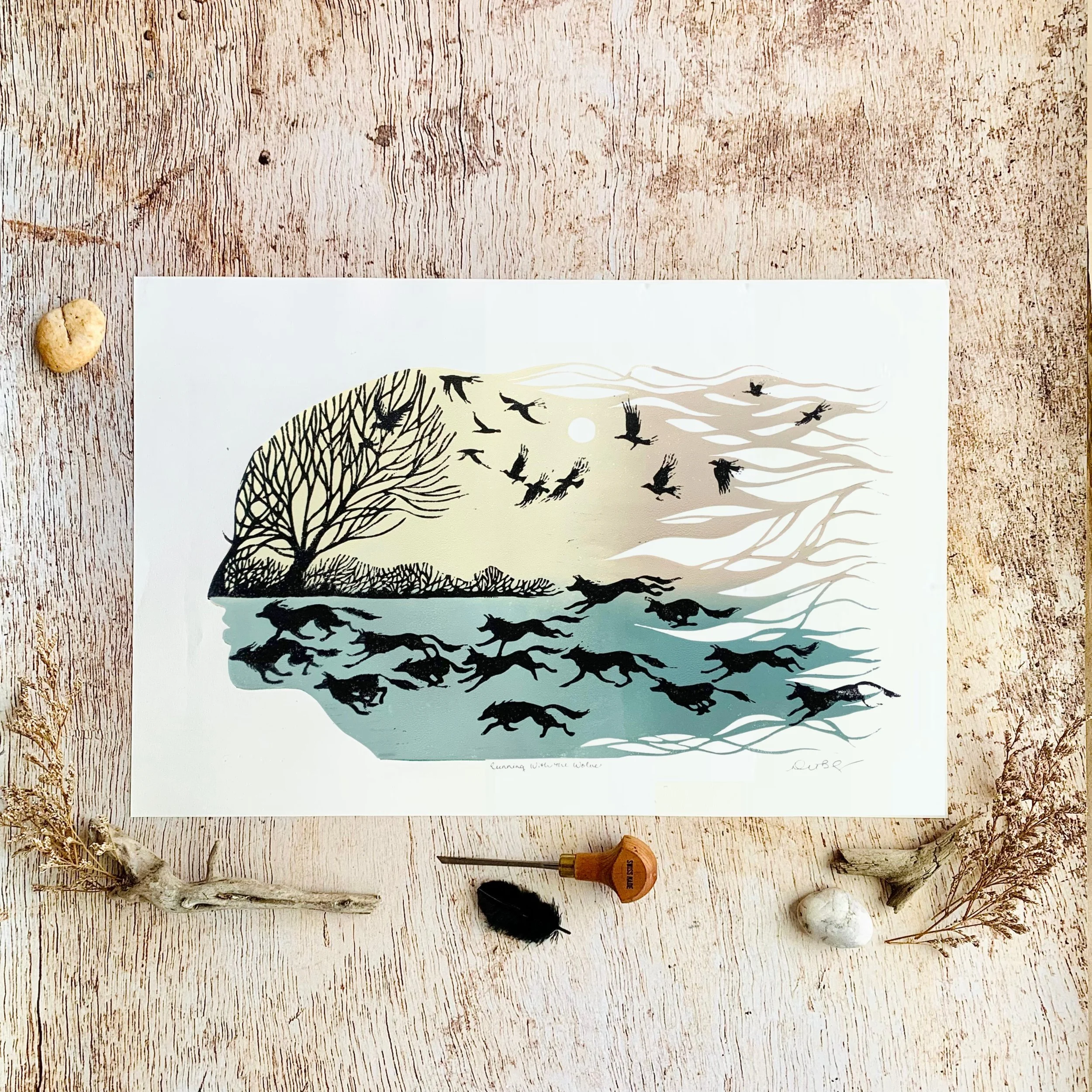
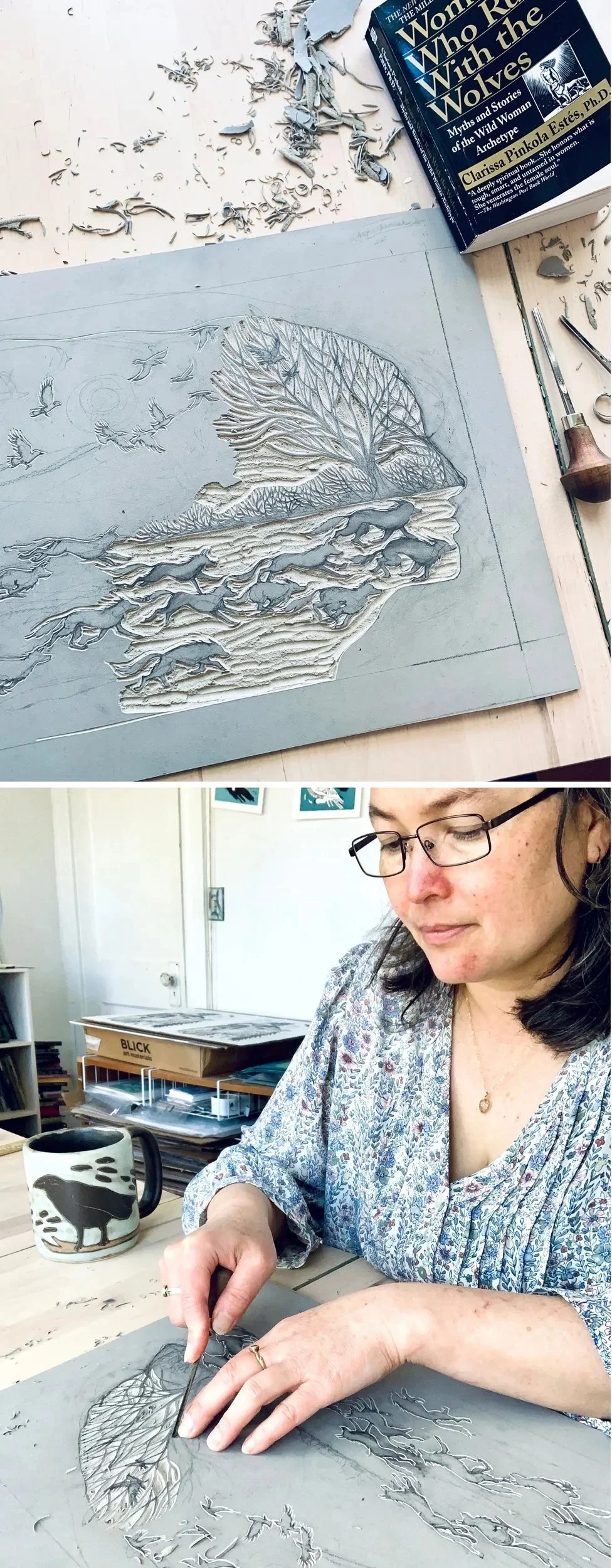
Running With The Wolves - a multiblock handcrafted linocut print
The same wound repeats itself across scales: in disrupted migration routes and fragmented ecosystems, in divided nations and severed cultural traditions, and in the bodies and identities of those who inherit these fractures. Borders leave their mark not only on land, but on memory, belonging, and the stories people tell about who they are. If the conservationists, Indigenous leaders, and restoration workers of the Southwest are gathering the scattered bones of a wounded landscape, who helps gather the bones scattered within ourselves?
The writer Gloria Anzaldúa, in her book Borderlands/La Frontera: The New Mestiza, describes the U.S.–Mexico border as an “open wound,” a place where the First World grates against the Third and bleeds. Her words speak not only of geography but of lived experience—the physical, emotional, and cultural pain carried by those who exist between cultural, racial and national worlds. Over twenty five years ago, it was through her that I came to name and recognize the border that cuts through my own racially, nationally, culturally mixed body. For years, I moved through life feeling that the world often seemed to require me to separate into manageable parts, that only fragments of me were visible at any given time, scattered like bones. Different versions of myself were welcomed in different places, yet the whole of who I was rarely felt seen which is why the myth of La Loba resonated so much with me. For years, I believed I needed to choose between competing versions of my story. Certain truths seemed to illuminate one part of my experience while obscuring another. Yet as I continued gathering the scattered bones of my own life, I began to see that the problem was not the existence of multiple truths, but my inability to hold them together. La Loba taught me that each bone carries its own reality. The labor is not deciding which truth survives, but learning how to gather them into relationship with one another. La Loba taught my own buried bones how to remember one another, showed me how they belonged to a single body. Her story, was wider than the scope of the stories that had been handed down to me to make sense of each of my parts, and illuminated what my existing stories could not each explain individually, that their gathering together could. She showed me I had to mourn, to grieve over what gets left behind when I try to fit myself into narratives that aren’t wide enough to hold me, she showed me how to sing myself alive again. Moreover, her story helped me recognize that beneath race, culture, language, and national identity were fragments of a larger living body—one whose forgotten wholeness also lies beneath many of the political divisions shaping our world today. It is that each bone holds a truth that is real and lived and the gathering of them awakens us to the labor required to cultivate the capacity to hold many truths together.
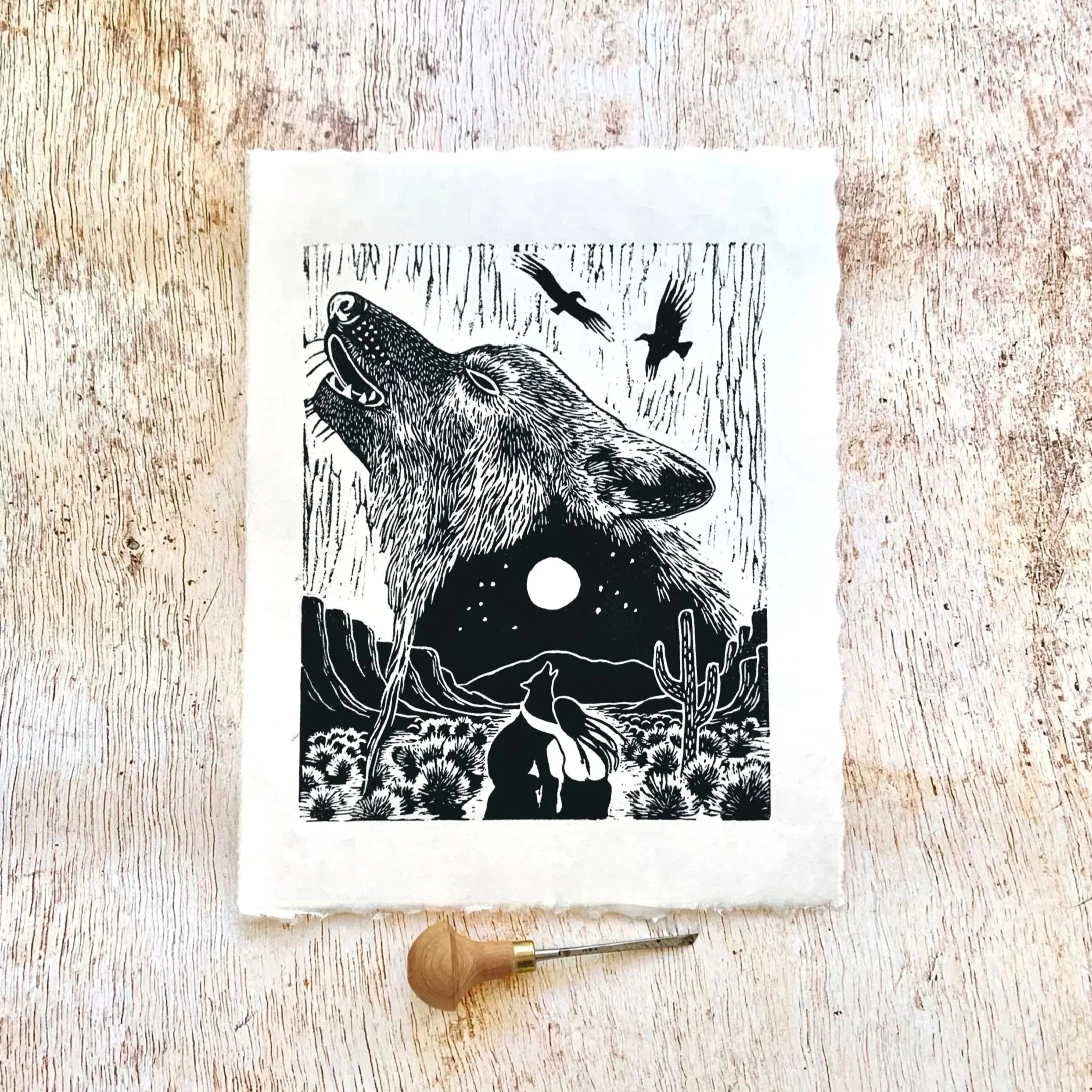
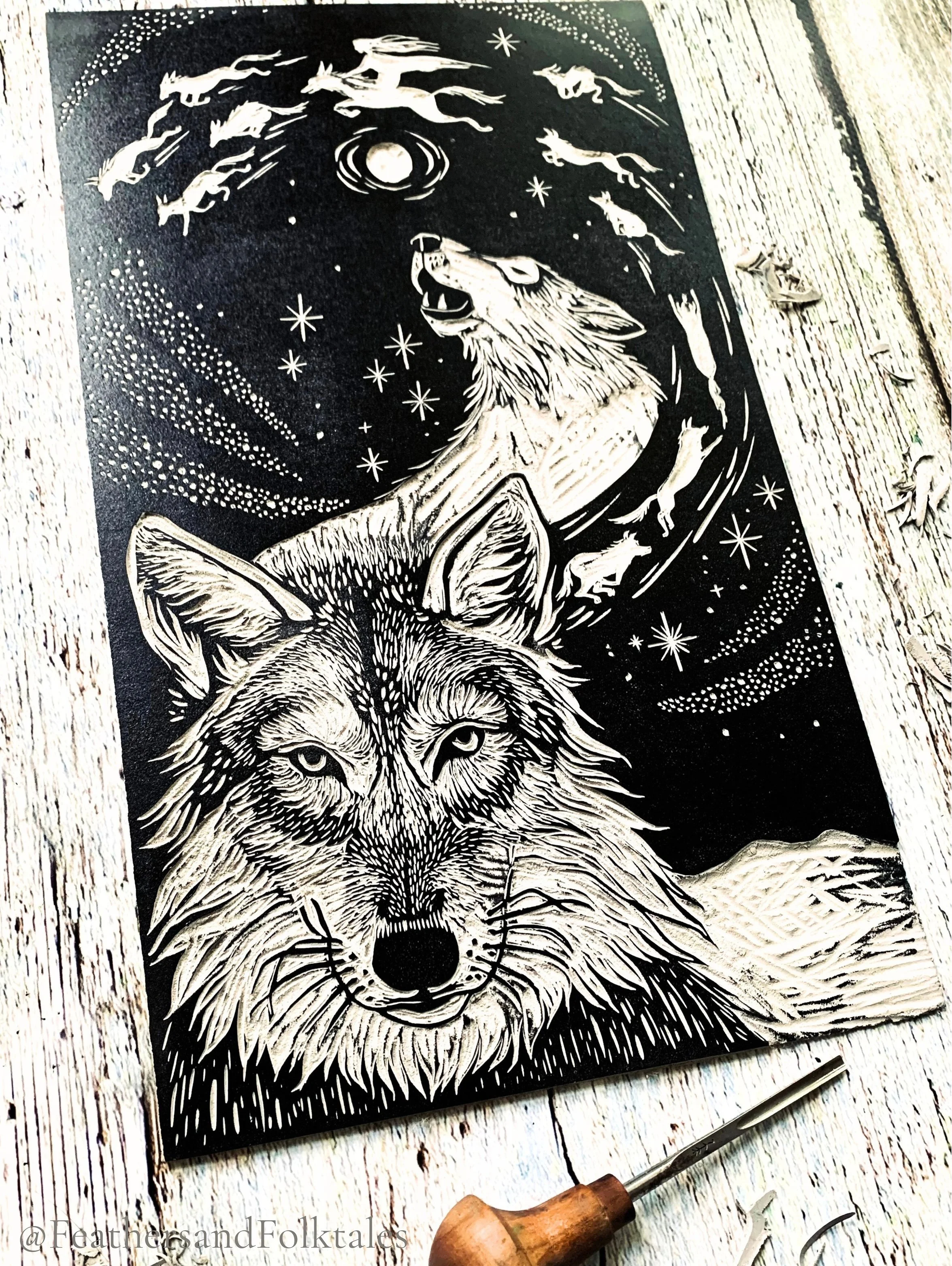
Howling with the Wolves linocut
La Loba’s song, though so ancient, is my song, but it is so much more than just mine. It is our song, the song our times. Like a deep voice from the past calling us to gather the bones, we must hold the truths together, to sing ourselves whole again. I believe the story of La Loba contains the wisdom that will carry us through our contemporary moment. I am reminded of La Loba’s wisdom in the midst of contemporary struggles over immigration, and the divisiveness and polarization of so many other issues. She asks us to recover the capacity to perceive wholeness wherever fragmentation has obscured it—not by denying difference, contradiction, pain, or conflict, but by allowing all the pieces to belong to the same living body. Like a voice carried across centuries, she calls us not merely to gather bones, but to recognize them—to notice what has been left behind by the stories we inherit and the narratives we use to make sense of ourselves and the world. For the deeper wisdom of La Loba is not that difference disappears, nor that contradiction can be resolved into a simple unity. Her wisdom is that wholeness requires the capacity to remain in relationship with many truths at once. Each bone she gathers carries its own history, its own reality, its own grief. La Loba's voice through Deep Time calls us to remember this and summons us to gather the bones into our collective arms—to cradle them, to sing over all of them, and to bring back the howl of the whole.
Wolf’s own fragmentation echoes the larger pattern of severance that La Loba’s myth refuses to forget. What is true of the body is true of culture. What is true of culture is true of memory. Something living is divided, and in the division we lose sight not only of what has been severed, but of how the pieces belong to one another. The heart of the myth of La Loba is the long mournful howl of a woman over the dismemberment of a body that was severed and not allowed to be whole - a body that we later learn is her own she is cradling and singing over. What she gathers back together is, in the deepest sense, herself. It is her own wild muzzle that twitches, her own flesh that gathers, her own bristly fur that lifts and her own limbs that quiver. It is she, the creaturely heroine, who awakens as Wolf alive once more howling into the darkness until bone remembers bone, and the scattered world gathers itself whole again.
Perhaps this is the labor La Loba asks of us now. To become gatherers of the bones our existing stories leave behind. To remain with what is missing, difficult to integrate, contradictory, and unresolved. To mourn what has been truly severed. To listen for what has been buried. And to cultivate the capacity to hold many truths together without forcing them apart. For the gift hidden within grief is not simply the return of what was lost, but the recovery of relationship itself. Bone answering bone, breath answering breath, story answering story, until the scattered world begins to recognize itself once more—not as identical pieces melted into sameness, but as a living body whose many parts belong to one another. And then, across the desert, the old howl rises again. Not the cry of a world made simple, but the song of a world remembering how to hold itself whole.
References:
Anzaldúa, Gloria. Borderlands/La Frontera: The New Mestiza. 1987. Aunt Lute Books.
Estés, Clarissa Pinkola. Women Who Run With the Wolves: Myths and Stories of the Wild Woman Archetype. 1992. Ballantine Books.
Kimmerer, Robin Wall. Braiding Sweetgrass: Indigenous Wisdom, Scientific Knowledge, and the Teachings of Plants. 2013. Milkweed Editions.
Nabhan, Gary Paul. “Walking the Line: The Cost of Lost Kinship When We Militarize Borders.” Kinship: Belonging in a World of Relations, vol. 2: Place, Center for Humans and Nature Press, 2021.
Swift, Sonja. Echo Loba: Of Wisdom, Wolves, and Women. 2023. Rocky Mountain Books.
“The Mission to Keep the Borderlands Wild.” National Geographic, February 2026.
United States Fish and Wildlife Service. Mexican Wolf Recovery Plan: Second Revision. U.S. Department of the Interior, Sept. 2022, https://ecos.fws.gov/docs/recovery_plan/Final%20Mexican%20Wolf%20Recovery%20Plan%20Second%20Revision%202022%20signed_508%20compliant_1.pdf. Accessed 7 June 2026
Zolbrod, Paul G. Diné Bahane’: The Navajo Creation Story. University of New Mexico Press, 1984.
More blog posts


What weaves its way like an underground warren beneath the borders of conquest and control, preserving our collective wild sisterhood with the earth across time, cultures and landscapes? The ancient link between hares, the divine feminine, and the moon journeyed from Asia to the Americas—carried by storytellers, pilgrims, healers, and wanderers. What might we reclaim if we traced their sacred steps?