
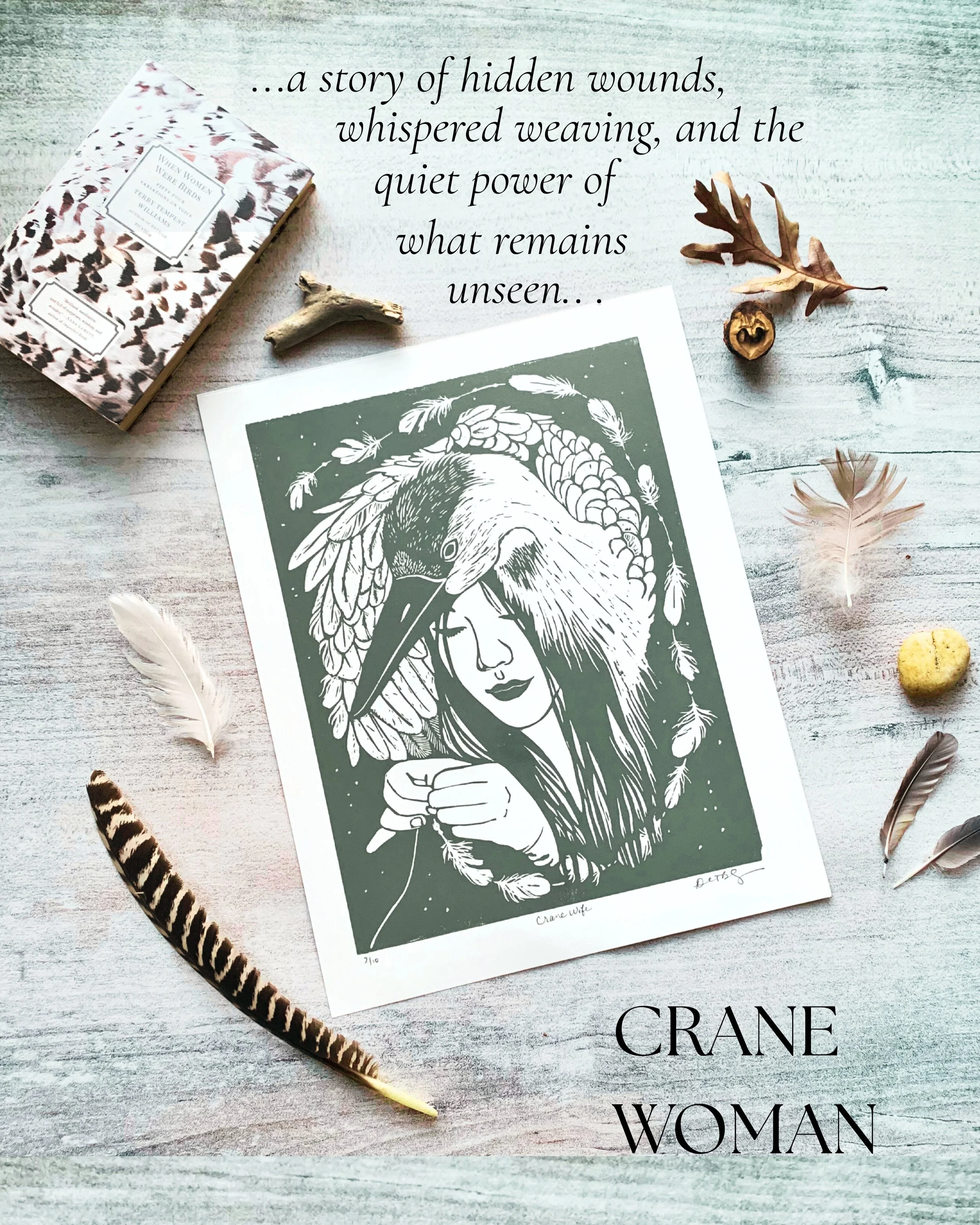
A handcrafted linocut print inspired by the Japanese folktale Tsuru no Ongaeshi (“The Grateful Crane”), also known as Crane Woman or Crane Wife. Here she is stitching together feathers from her own body. . .
How might an old folktale—one that explores a marriage between a human and a crane—deepen our understanding of our relationship with the more-than-human world, both around us and within our own bodies? The Japanese story Tsuru no Ongaeshi (“The Grateful Crane”), also known as Crane Woman or Crane Wife, draws us to the tender edge where love and mystery meet, inviting a deeper reckoning with the cost of wanting to know too much and the loss experienced when the veil is pulled back too far. It suggests that when the threshold of what is meant to be kept sacred is crossed, the very spell that sustains relationship is broken. At its heart, the tale offers a bittersweet medicine: a remembering that enchantment lives not in what we uncover, but what we are willing to honor and protect.
The story begins with a poor man who finds a beautiful white crane trapped in a hunter’s net. Moved by compassion, he frees the bird. Some time later, as dusk settles and the memory of the encounter begins to fade, a mysterious woman appears at his door and soon becomes his wife. They live together happily; she tends the household with remarkable care and skill, yet asks one thing of him—that he never watch her while she weaves in a private room from which she produces cloth of extraordinary beauty. In time, curiosity begins to take hold. Unable to resist, the man breaks his promise and peeks inside. To his amazement and horror, he discovers that his wife is the white crane herself, plucking her own feathers to weave the luminous cloth. Discovering her husband has broken his promise, the Crane Wife weeps and cannot stay; she lifts her wings and vanishes into the sky. He is left with the hollow weight of his betrayal and what it has cost him and lives out his days alone, haunted by a loss he cannot undo.
Clearly, this story bears witness to a rupture in relationship—a kind of spell-breaking. It sings of the deep ache that rises when a closed door is pried open against a promise, when trust is shattered and the fragile intimacy between two worlds slips away. In our own time, there are echoes of this rupture in the ways humans have violated the living world. Nature, too, has felt the Crane’s quiet sorrow, her ache of betrayal by human hands, both past and present. Only a few hundred years ago, this breach was bound up with the culture of conquest, industry and extraction of both human and natural resources. It was driven by a desire to “save” and “civilize” what was deemed wild—lands and peoples living in deep relationship with the earth. Within this infolding of history, an echo of the folktale emerges: that a gesture in the name of “rescue” can carry an unseen claim upon the soul, a hidden tether of obligation that ensnares the other into a captive life not wholly their own.
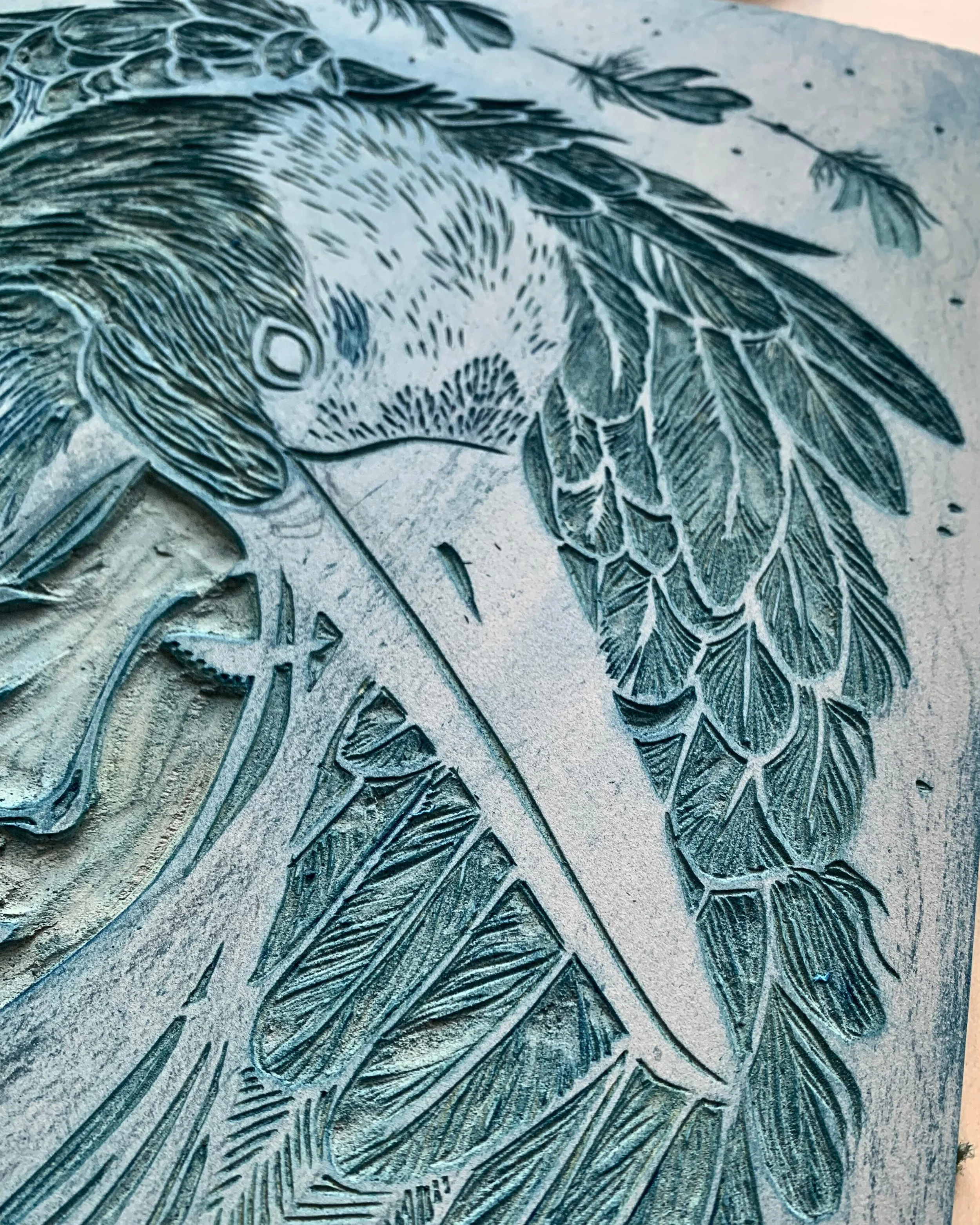
A handcarved block of artist’s linoleum inspired by the folktale of Crane Wife / Crane Woman.
Scientific inquiry, far from neutral, emerged in part as a tool of this larger enterprise. Though the scientific acts of naming, cataloging, and classifying deepened our human understanding—offering extraordinary gifts that benefit many today—we are now reckoning with its hidden and often unspoken cost. Perhaps most profoundly, when the wild is reduced to data, scrutinized under the microscope, her freedom taken in the name of mastery, her voice forgotten, her closed door no longer honored but opened to an uninvited gaze. She is no longer met as a being, but claimed as a possession. She becomes an “it”.
Carl Jung gave voice to this very disconnection in his book Man and His Symbols: “As scientific understanding has grown, so our world has become dehumanized. Man feels himself isolated in the cosmos because he is no longer involved in nature and has lost his emotional participation in natural phenomena… Thunder is no longer the voice of an angry god… No river contains a spirit… No voices now speak to man from stones, plants, and animals, nor does he speak to them believing they can hear. His contact with nature has gone, and with it has gone the profound emotional energy that this symbolic connection supplied.” This loss of symbolic connection mirrors how, when we strip the wild down to facts and functions alone, we sever the very living, ensouled presence that once spoke to us and through us.

Whooping Crane from Birds of America (1827) by John James Audubon (1785 - 1851), etched by Robert Havell (1793 - 1878). Photo credit: Wikimedia Commons.
The tension at the heart of science—the gift and the cost—is mirrored in the devoted works of those Western scientists, naturalists and artists who genuinely tried to understand the wild more deeply. John James Audubon, naturalist, artist and ornithologist who made extensive detailed studies and illustrations of North American birds, gave generations a way to behold their beauty and functional anatomy while also participating in an approach that required killing, measuring, and cataloging his subjects. Though the drawings rendered birds in exquisite detail, inviting admiration, fascination and deepened human understanding, he overlooked the birds’ subjectivity, their living presence in Indigenous stories, and their cultural significance, redirecting our attention from meaning towards detached aesthetic curiosity. In other words, with Audubon’s book Birds of North America (1827), we open the pages and gaze at the bird, but she does not gaze back. This impulse to observe, surveil, catalog, and master captured in the pages of Audubon’s book is entangled with a gaze that beautifies even as it claims. a hunger disguised as admiration. His manner of seeing the wild was entwined with the long human history of naming, dominating, and claiming lands and peoples—rendering the natural world extractable, and human beings subject to possession, forced labor, and control. As in the Crane Wife, we might ask: did his admiration of her and her “rescue” extend her life, or did it draw her into a different kind of captivity — a benefit to him at a cost to her? The story suggests the weight of a kindness that carries its own cost. Here, in the man’s prying behind the door, his secret surveillance, his insistence on her control, a trust is broken and intimacy undone. Echoing the folktale’s arc, the long pageant of history reveals how science has similarly bent toward conquest and industry. In the name of “saving” and “civilizing,” it sought to control and surveil lands and peoples until the deeper truth slips from memory: that the wild breathes, weeps, and is a presence alive, and ensouled with a voice that requires honoring and protection. In forgetting this sacred truth, she becomes a silent guest trapped in a house that was never ours to claim.
This gaze is present in the works of Leonardo da Vinci, whose meticulous studies of bird wings revealed the mechanics of flight, and Sir George Cayley, similarly a pioneer of aerodynamics, studied the functional anatomy of bird’s wings to understand lift and motion. Both men drew the mystery of flight out of the living world and set it into the language of engineering, where it has served and benefited many; yet like the drawings of John James Audubon, it bears the trace of a severing—an absence of soul, a quiet disenchantment. Stripping phenomena to atoms and mechanics risks losing the living presence, the personhood, and the reverence of what is studied. Their drive to fully analyze these creatures who had once been ensouled echoes the story’s caution: in pressing too far, something vital slips away.
In contrast to Audubon, Da Vinci and Cayley’s approach to birds, in these Northeastern Woodland landscapes I call home, there is an Abenaki folktale of Wabi, a luminous white Great Horned Owl, who courts a human heroine. In his charming pursuit, he shifts between owl and human form, but only when he embraces his true owl nature—risking himself to protect her people and claiming attention on his own terms—does the heroine recognize his devotion, revealing a bond born not of human dominance but of mutual presence, respect, and relational mystery. Here, the wild is not a backstage setting for a human drama, nor a decorative object of human desire, but a presence with his own will and way of being. In the tale, the owl’s gaze meets the human heroine’s as a co-witness in a dance of recognition; the story models a seeing that is mutual, alive, and sovereign. In the Crane Wife tale, as in Audubon’s book, the gaze falls out of balance: he looks where he is not meant to look, hidden from her knowing, and his seeing becomes a subtle form of taking—one she cannot meet, only escape, as she vanishes beyond his reach.
When we speak of “nature,” we can also include ourselves—our own bodies—and, in the context of this story, women’s bodies in particular. The tale opens with a wounded crane, whose injured body echoes the place of wounding many of us begin. From the moment we are born and throughout our lives, girl’s bodies are surveilled, judged, and “corrected,” all at the cost of bodily sovereignty. Like the Crane Woman, we are taught to contain our wildness, to hide it, to tame our instinctual selves and pluck out our own feathers, crippling our flight, to become acceptable at the cost of losing what is alive within us. Very much like the culture of conquest, industry and extraction strove to save, control and dominate wild landscapes and people, a similar parallel culture does the same to women’s bodies through the pressure to diet, fit a certain body size, resist aging, and the resolve to perform to a point beyond exhaustion to meet external demands. The same Crane Wife tale also mirrors our own interiorized relationships with our own bodies, where the husband and crane live as different voices within the self, negotiating freedom and constraint. The story reflects how this relentless scrutiny and control - both from within and without - can disenchant our relationship with our own bodies. Like the man in the folktale, we have trapped our own wounded bodies into a quiet marriage of domestication. Our own self-surveillance and control of our innate wildness becomes a form of self-betrayal. A form of disembodiment slowly takes place until the instinctual self, our inner creaturely heroine takes wing from a place she no longer feels safe to inhabit.
This is especially poignant for women who experience chronic pain, tragic illness, unresolvable or cyclical menstrual pains or the aging process including the menopausal transition. In these moments, the body is not a problem to be solved, it is not broken. Like the crane, our body remains a “she”—alive with feeling. The body’s pain is the body’s voice is asking to be heard, honored and protected. Yet too often, we are taught to trespass this sacred bond through surveillance and control at the cost of attuning to our own body’s needs, rather than creating the conditions of safety and boundary through which our body feels safe, and can show up and be welcomed as she is. When we pry open the door in effort to scrutinize, control and fix our bodies, we risk only seeing the organs and vessels, how they function or how they fail, and from this place of diminishment, we become blind to recognizing the body’s worth as an integrated ensouled whole. As Audubon, Da Vinci, and Cayley did with the bodies of birds—the drive to dissect, measure, and catalog our own bodies—we risk relating to our bodies from a detached place of estrangement, rather than inhabiting them. We may become untethered from the messages our bodies could potentially be communicating with us as sensory feelers who offer us the pleasure of sight, sound, taste, smell and touch -all of which would make our bodies loyal allies, sacred keepers of wisdom, and intimate guides*.
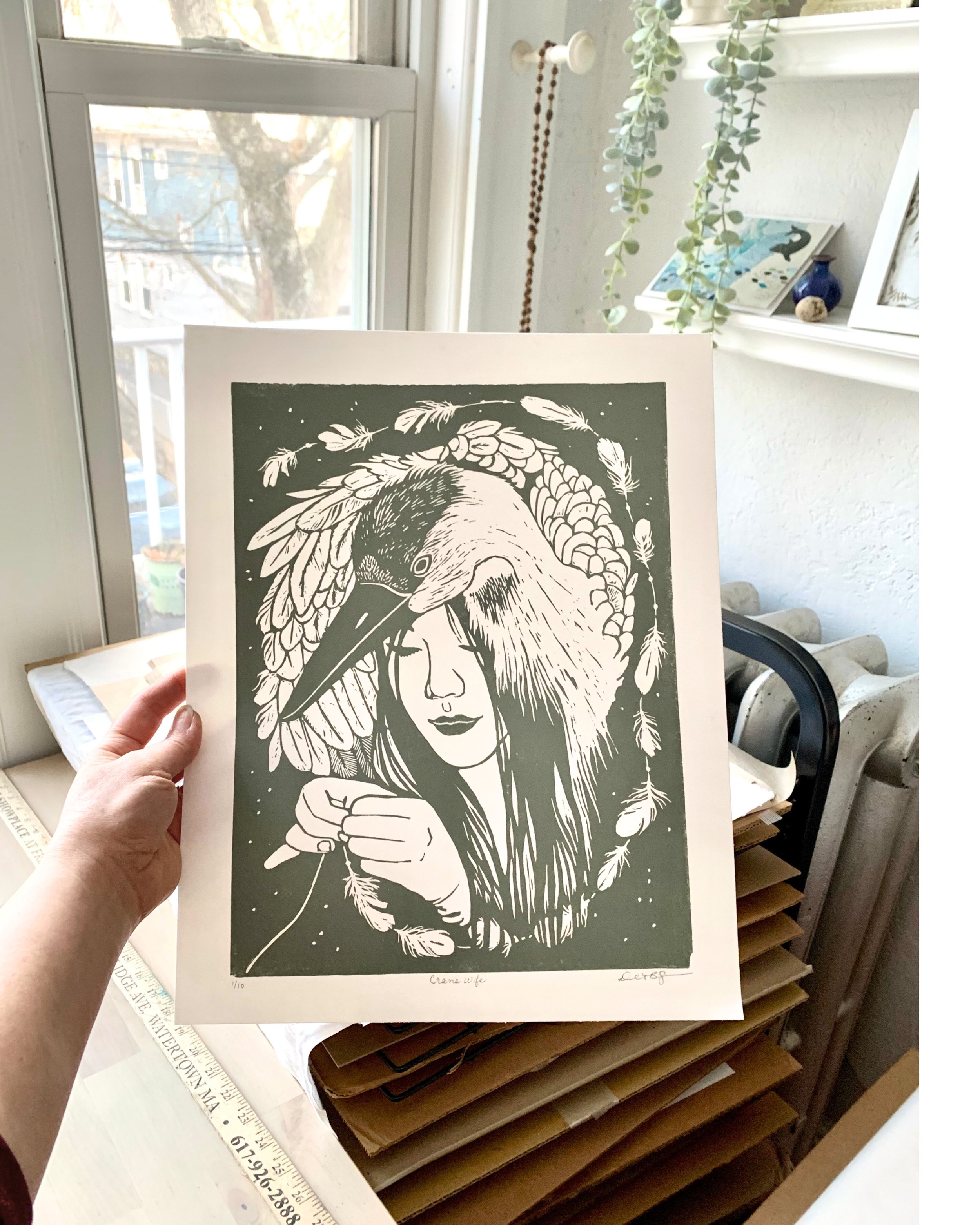
You can also invite Crane Woman and her wisdom into your life by purchasing my linocut print inspired by this folktale, in my shops! Under the world’s gaze, we shape ourselves to be seen and forget our own value. But in solitude, the Crane Woman weaves from her feathers a cloth of quiet splendor from her own feathers. It is here, beyond all watching, that she comes to know and honor her true worth.
There is a growing awareness of relating to the body not as a problem to be fixed, but as a living being with her own voice and will. In The Body Says No, Dr. Gabor Maté suggests that many illnesses, aches, and chronic conditions arise not only from external causes, but from the quiet, repeated silencing of our own needs—when we override the body’s truth in order to belong, to succeed, or survive. His work is striking in that it comes accross more like a dialogue between empirical knowledge and embodied wisdom. Like the Crane Wife, who lives bound by an unspoken obligation, our bodies, too, carry the weight of having adapted—of having submitted to a kind of captivity at the cost of something essential: freedom. When a true longing remains unexpressed, the body begins to bear what cannot be spoken. In the folktale, the Crane plucks her feathers in the quiet of her room—each one a small act of self-betrayal, each loss a wound that refuses to close—until her capacity for flight is slowly undone. So too within us, what cannot be spoken is taken up by the body, carried in silence, until it brings us to the edge of what can no longer be endured.
Yet the story of the Crane Wife does not end in wounding; it turns, quietly, toward what the wound makes possible. She is not only plucking her feathers, but weaving them into cloth—what is taken from her body becoming the very material of creation. In this turning inward, in this tending to the body, something shifts: the garment she weaves begins to take on a life of its own, a living emblem of the self she is slowly coming to claim. Here, the tale reveals the wounded body as an initiatory ground. The weaving of the feathered cloth mirrors the soul’s becoming.
This same wisdom echoes through contemporary voices who are relearning how to listen to the body not as an object, but as an ensouled guide. In The Body Is a Doorway, Sophie Strand reframes her illness not as a personal failure or brokenness, but as an expression of the body’s entanglement with the wider living world.
By listening to its signals, she comes to see illness as a threshold—an opening into transformation, initiation, and deeper ecological belonging. Dr. Aviva Jill Romm, in her book Hormone Intelligence, suggests that a woman’s hormones are not unruly forces, but sacred messengers: an inner compass attuned to currents beneath the surface, signaling what stirs in shadowed places. Rather than something to control, the body becomes something to be in relationship with—listened to, tended, and trusted. In a similar spirit, Alexandra Pope and Sjanie Hugo Wurlitzer, in Wise Power, reframe menopause as a powerful, transformative rite of passage—not a crisis, but a threshold—offering guidance to embrace its potential for awakening authority, purpose, and belonging. Taken together, these perspectives return us to the same initiatory landscape the Crane Wife inhabits: one in which the body’s wounding is not meaningless, but part of a deeper process of becoming. Like the Crane Wife, who plucks her feathers to weave, the labor of turning inward becomes the crucible of change—through which a new self is slowly, painstakingly formed.
A similar wisdom lives in the Japanese art of Kintsugi, where broken pottery is repaired with lacquer mixed with gold, silver, or platinum, the cracks not hidden but illuminated. Rooted in the philosophy of Wabi-sabi, it honors imperfection and reveals beauty in the history of breakage and repair. It is the story of the ensouled wound—the understanding that the inner work of the soul is the gold that transforms what is broken into something more whole, more singular, and more alive than before. Such sacred labor often asks for withdrawal, for protection, for a space held apart and tended. This protected space, the Crane Wife names up front:it is the sacred promise that must remain unbroken if their marriage is stand. It speaks to a deep remembering: that in times of transformation, one must be cradled within a mythic den where the work of becoming can unfold. For it is only within what is held and honored that the soul finds the courage to become whole again. It is a remembering that not all things are meant to be opened, and that true seeing is an act of protection, not possession.

At the threshold where this Crane Wife story and the outer world converge, we see a pattern emerge: when we impose our gaze, our measurement, our will, the living wild—and our own bodies—can be diminished; yet when we honor and protect what is wild and ensouled, a relationship thrives. The relational mystery remains whole, unbroken, and luminous. The Crane Wife reminds us that knowing has two faces: one that looks in reverence and keeps its distance, dwelling beside what it loves, and one that looks to possess—a voyeur’s gaze that ensnares and entraps. The difference is not in the eye, but in the posture of the one who looks. Science has given us profound ways of understanding the world, revealing patterns, structures, and unseen intricacies that deepen our sense of wonder. And yet, when knowing becomes untethered from relationship—when it forgets to ask what must remain protected—it can cross a threshold from admiration into intrusion, from a gaze of curiosity to one that ensnares a life to another’s keeping.
Perhaps ultimately the tragedy of the crane wife is not that she was discovered—but that she believed she owed a debt to the one who named himself her savior. How many of us have sat in silence, feather by feather, trying to earn release from a cage not entirely of our making—yet one we have come to unknowingly inhabit? In the words of Tiokasin Ghosthorse, Cheyenne River Lakota elder, about consciousness and how the language we use can colonize the mind, “We had to adjust, to standardize our language so that we could speak it in English. . .taking away the very essence, the energy, the wakan of everything. The ability to apply mystery to everything. . . .Let’s stop learning about Earth and learning from Earth”.
Crane Wife is haunting yet luminous story of embodiment, tracing the journey of wounds toward healing through tending, listening to and honoring the living body. Though this tale is from Japan, cranes feature in many folktales across Asia. In Vietnam crane is the Great Mother, the Creation Mother who births the world. In Lao and Thai Buddhist folklore there is the White Crow or White Raven Ka Phuak, whose five eggs hatch into the Five Buddhas-to-be. In other landscapes and cultures there are, similarly, creaturely feminine mothers who birth the world from their bodies. Among the Navajo she is Na'ashjé'ii Asdzáá Spider Grandmother, who weaves the web or fabric of the world from her body. At their heart, all these tales sing of the creaturely heroine mothering: of a body opened—her feathers drawn and woven into the very cloth that frees her, or silk drawn from her own body and spun into the web of the world, or a body given over to new life, a hundred children hatching from her eggs into the world. And in their telling, we are gently turned back toward the earth—not as an it, but as a living being with a voice of her own, whom we may yet learn to listen to, and in listening, come to know her limits as our own.

References
Bruchac, J. (2006). Wabi: A hero’s tale. Dial Books.
Ghosthorse, T. “Consciousness.” Sounds of Sand Podcast, 24 Feb. 2026.
Jung, C. (1964). Man and his symbols. Dell.
Kimmerer, R. W. (2013). Braiding sweetgrass: Indigenous wisdom, scientific knowledge, and the teachings of plants. Milkweed Editions.
Maté, G. (2011). When the body says no: Exploring the stress-disease connection. John Wiley & Sons.
Pope, A., & Hugo Wurlitzer, S. (2022). Wise power: The liberating power of menopause to awaken authority, purpose, and belonging. Hay House.
Romm, A., M.D. (2021). Hormone intelligence: The complete guide to calming hormone chaos and restoring your body’s natural blueprint for well-being. HarperOne.
Strand, S. (2023). The body is a doorway. Spiegel & Grau.
More Bird Blog Posts


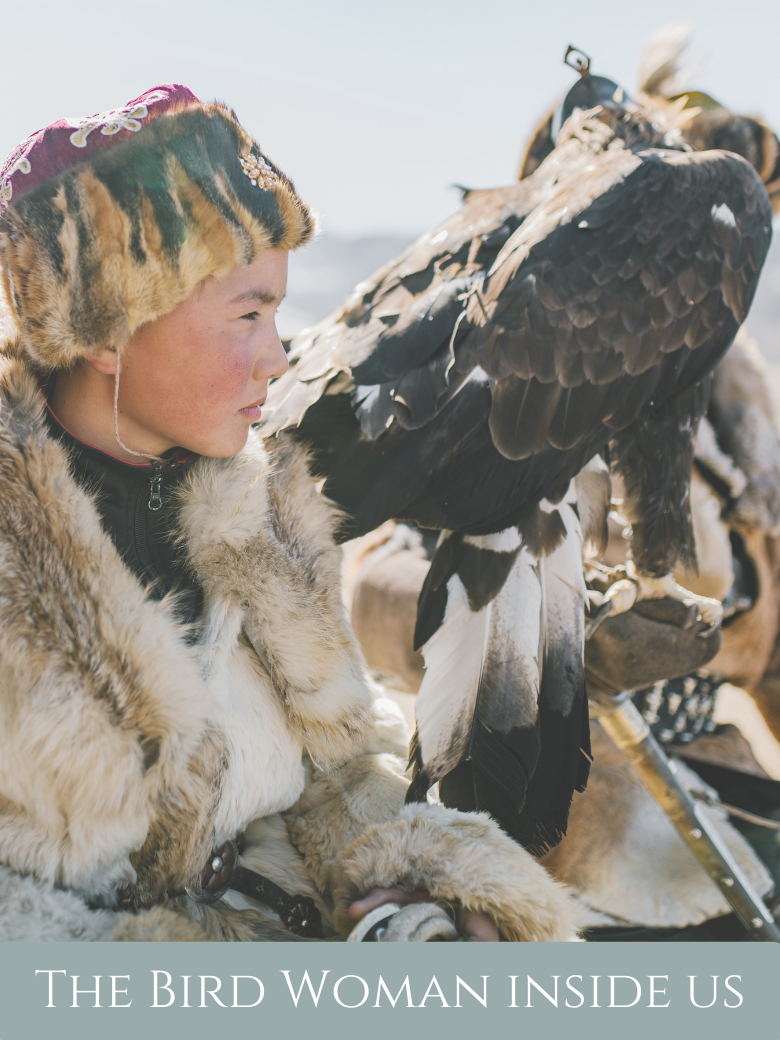
Singebis is an ancient Ojibwe winter folktale about a beloved folk hero and wild grebe whose perseverance, courage, resilience, and loyalty in the face of Kabibona'kan, Winter Maker, shows us we can do the same in the face of adversity. This story asks us to reflect on what kinds of Kabibona'kans do we face in our lives today that threaten to divide us from others who might be our friends? This folktale reminds us we all have the capacity to tap into our inner Singebis, find our inner trickster, and remind ourselves that even a little wild bird can outsmart the Winter Maker!