
As winter settles in and we turn toward rituals of warmth, hibernation, renewal, and dreaming, Bear slips quietly back into our imagination, reminding us that old earth wisdom still walks on four paws. Deep within our ancient and living heritages, Bear is remembered not as a beast, but as a threshold being—one who journeys with us between worlds. Across the long memory of this wild, storied Earth, Bear has figured prominently in the human cultures of the boreal circumpolar regions which, in ancient times, stretched much farther south than it does now: temperate hills, plains, and valleys—from the Carpathians and the northern Mediterranean to northern China, Japan, Korea, and the Appalachians and Rocky Mountain foothills—were once cloaked in resin-scented forests of spruce, pine, birch, and larch, shaped by long winters and patient, slow rhythms. In these landscapes Bear bones have been found ceremonially and intentionally buried with preservation in mind, treated in ways strikingly different from other animals, and this is amplified in folktales and myths describing Bear as a human clothed in bearskin, and as lover, mother, child, healer, midwife, shaman, or guide. Bear’s seasonal descent into hibernation and emergence in the spring is evoked in ancient and living ceremonies and rituals that mirror the inner thresholds we are asked to cross: a journey from one stage of life to another; a renewal after a descent into darkness; and the restoration of balance after the upheaval of transition. From this liminal ground, Bear moves alongside the psyche at its crossings, weaving one season of the soul into the next, holding the space where old forms dissolve and new ones take shape, and tenderly watching over all that must be born, shed, and transformed. In the following exploration we discover whenever Bear appears, we find a hallowed den—a living, fluid space where psyche and nature, creature and cosmos curl together as one. Here, Bear gathers us close, warm and steady, while change reshapes us.
Bear as Kin
Again and again, when humans stand at the edge between survival and solitude, Bear steps forward—not as prey, but as kin. Across the Arctic, Northern Europe, and the American Pacific Northwest, Bear arrives where the boundary between human and wild begins to soften, where mutual care must be learned and given in order for life to continue.
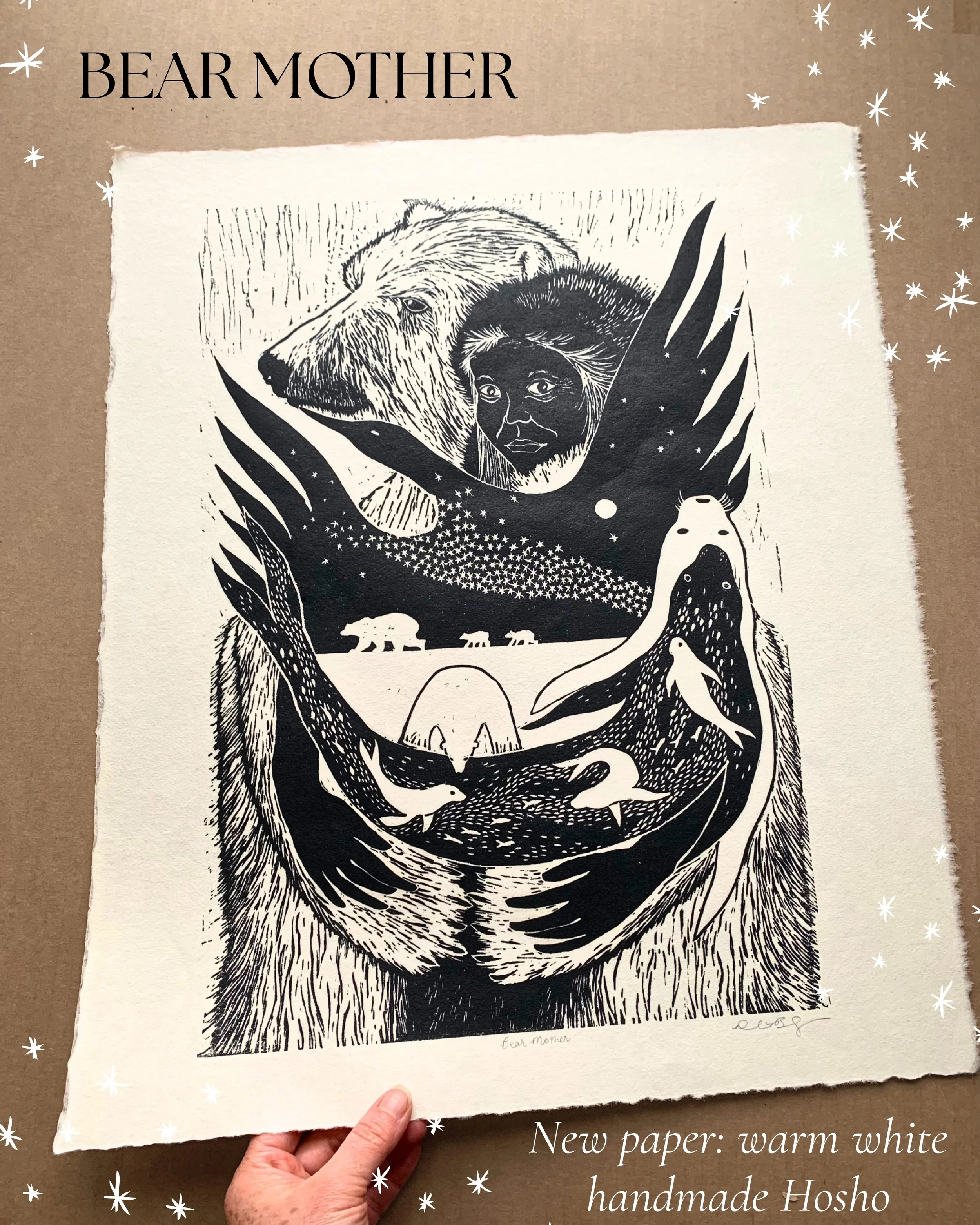
Among the Inuit, an ancient legend tells of an elder woman who discovers an abandoned polar bear cub. She feeds him, shelters him, treats him as her son drawing him into the intimate rhythms of human life. As he grows, the relationship turns—not away from dependence, but toward reciprocity. He protects her, provides her with seal meat, ensuring her survival. In this telling, Bear is not an animal set apart for fear or conquest. He is the threshold itself, a passage, the place where the distance between human and wild closes. Here stranger and kin, once worlds apart, are held in Bear’s presence until they soften toward one another. In the presence of mutual care and reciprocity, the world makes room—quietly, precisely—for a new form of belonging to take shape between them.
Ancient Scandinavian folktales echo this same loosening of boundaries between humans and the wild. Stories tell of Bear abducting human children, returning them only when the people agree to name the child after Bear, binding identity itself to more-than-human lineage. The child grows bearing Bear’s qualities—strength, ferocity, presence—and becomes the ancestor of a people shaped by that kinship. Other Scandinavian tales speak of women who bear children with Bear, their offspring marked by an unusual Bear-like vitality. Even ritual carries this knowing forward. In the Dalarna region of Sweden, the bride and groom-to-be are called “the Bears” during the liminal period between engagement and marriage. For a time, they live under Bear’s name and are ushered into their new home, called the “Bear’s Den.” Once married, the Bear title falls away, and Bear steps back into the wild, leaving the den behind—yet it was Bear who held the couple within the charged uncertainty of becoming, where old forms dissolve and new ones are not yet stable, until marriage could safely take hold.
In Norwegian folk memory, Bear stands beside the birthing bed. A paw drawn gently across a pregnant belly was said to ease labor’s pain, and those who had survived a bear’s mauling—bodies rearranged by proximity to death—were trusted as the best midwives. They had already crossed a perilous threshold and returned; their flesh remembered what that passage demands. The encounter with Bear did not grant power over birth, but familiarity with its danger and intensity, a bodily knowledge of that dangerous passage and how to stay present at the edge where life breaks open. Here, Bear is not metaphor alone. Bear moves through hearth and household, reminding humans that life enters the world through vulnerability held, through bodies shaped by what they have endured. Birth, like all true transformation, requires companionship, endurance, and the courage to remain with pain without turning away. Bear offers that presence here, keeping watch in the dark until the new life finds its way through.
In the Iyomante, the “bear-sending ceremony,” practiced by the Ainu, an Indigenous people of what is now northern Japan, Bear is raised as a cub within the human village, sometimes even within the household itself, cared for with great tenderness and respect. Bear as cub sleeps among people, eats their food, learns their rhythms—sometimes even nursed like a human infant—one family, one shared den. This is not an act of domination, but of kinship: a weaving of belonging across worlds. When Bear is released, Bear crosses back into the wild carrying the trace of human care—the relationship across living worlds woven into its passage, and the threshold time for the humans who experience it is marked and infused with the essence of Bear.
Taken together, these stories do not argue for Bear’s importance—they remember it. Bear is not merely hunted, studied, or mythologized. Bear is invited in. Bear is fed and Bear feeds in return. In this ancient weaving, kinship stretches beyond the human, and survival itself depends on learning how to live inside relationship rather than through control, conquest or fear or subjugation. Bear teaches that belonging is not a possession, but a practice—one learned at the threshold where wild and human meet and agree, however briefly, to care for one another as kin.
Bear as Season and Cosmos
Beyond hearth and household, Bear also walks among stars, seasons, and ancestral beginnings—appearing wherever time begins, threads her way, or loosens her grip.
In Vietnamese folk astronomy, the heavens are not distant abstractions but an intimate stage of cosmic courtship. The Jade Emperor, or Sky Father Ông Trời, fathers two daughters: the Sun Goddess and the Moon Goddess, who share a lover: Bear. When the sun or moon darkens in eclipse, it is said Bear is passionately intimate one sister or the other or is moving between them, holding the tender tension of desire and entanglement in a celestial drama. In this telling, humans can rest assured the cosmos is neither broken nor ending—it is momentarily experiencing a romance à trois. Light yields to shadow, not as catastrophe, but as a threshold den of entwined hearts, and we, watching from below, are both enraptured by the unfolding love story and cradled by Bear’s enduring presence through the sky’s unfolding spell.
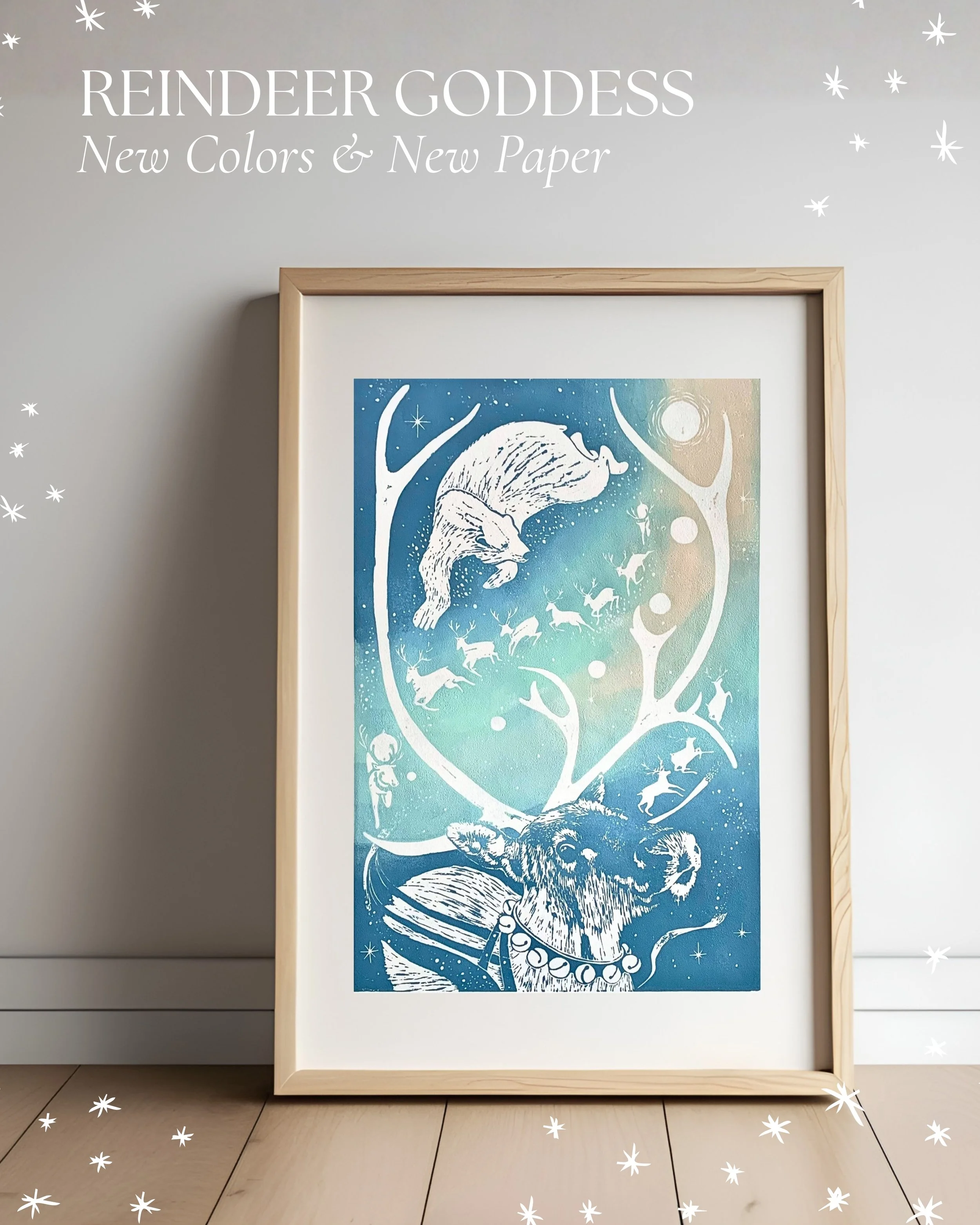
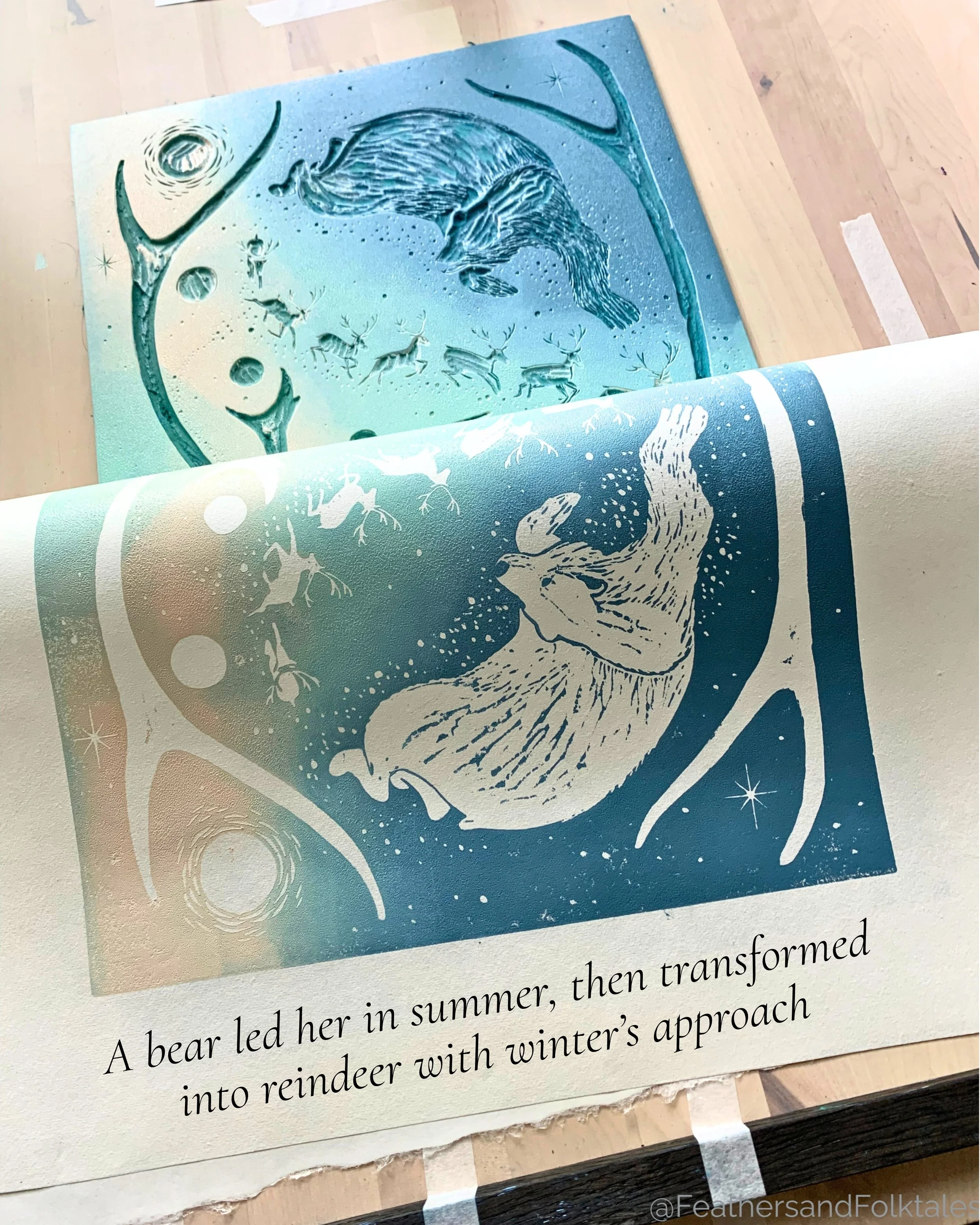
The Sámi reindeer who carries the sun between her antlers in the winter, and turns into a bear as the summer approaches.
Among the indigenous Sámi of Finland and Estonia, Bear carries the turning of the year itself. As winter recedes, the sun rides between the antlers of a reindeer goddess, and when summer awakens, her herd becomes Bear, who bears the light forward, strengthening and returning it to the world. Time is not measured by calendars or clocks, but is guided by fur and breath, by the slow, living rhythm of Bear’s passage through the seasons—a threshold keeper, moving the year itself from sleep to waking, from shadow into light.
In Romania, the ancient Mersul cu Ursul “Bear Dance” is performed each year between the old and the new year. Participants don bear skins in a dramatic enactment of Bear’s hibernation and return. The drumbeat is a heartbeat; the fur, a hallowed cloak; the steps, a passage through shadow into light. Here, Bear holds the threshold, carrying the community across the fragile border between what is dying and what is becoming. The dancers do not merely observe the turning of the year—they enter it, moving with the rhythm of the seasons. Within the den of the dance, they learn that time itself can be tended as a sacred, living presence, trusting as Bear moves through them, they are in communion in the dance that weaves endings into stirrings, carrying what is passing into what is being born.
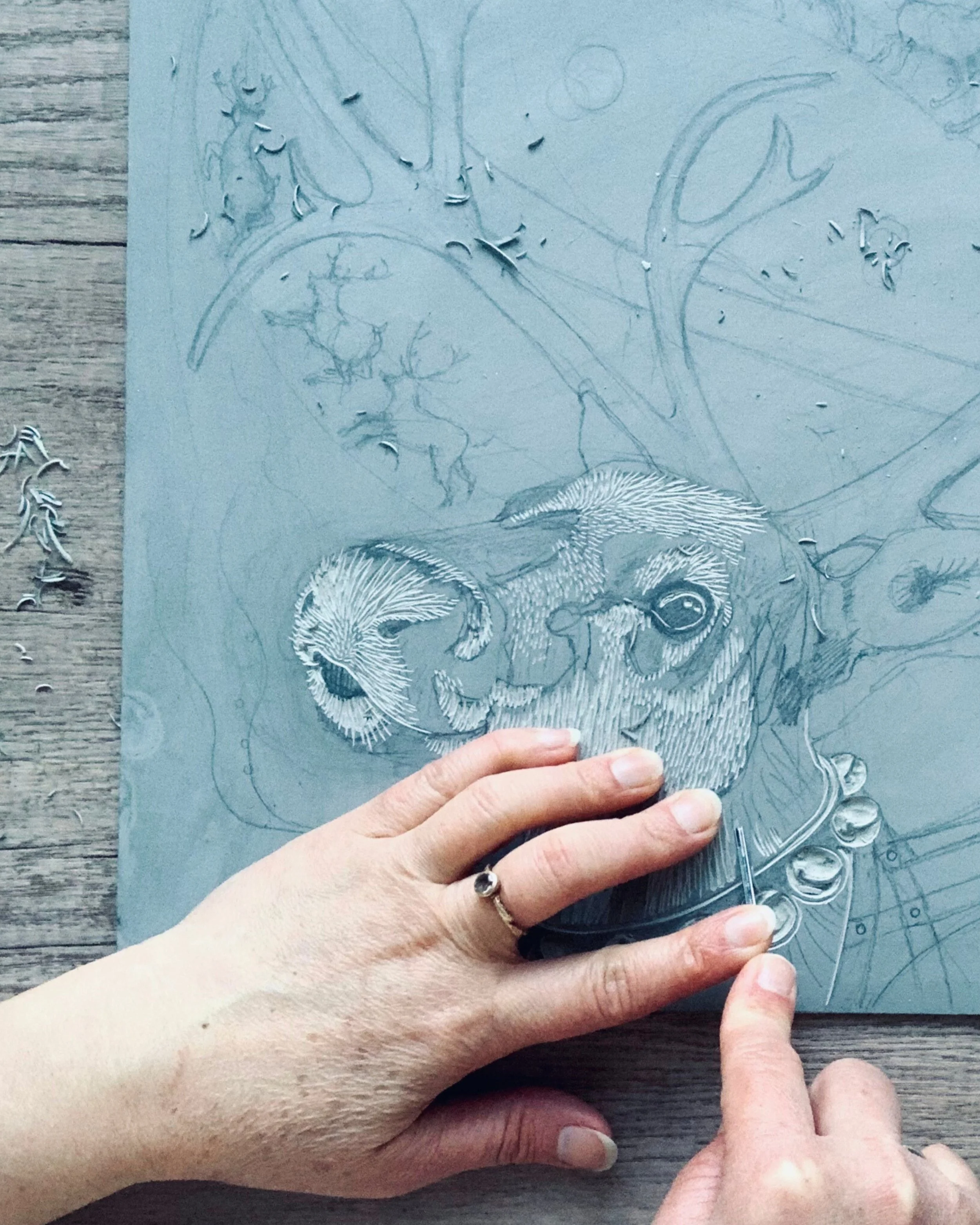
Bear also appears when time begins. In the Korean myth of origin, Bear endures trial and isolation, transforming into a woman who gives birth to Dangun, founder of the Korean people, ancestor, womb, and bridge. Similarly in Finnish tradition, Otso the Bear is progenitor, and cosmological anchor around which clan life coheres. Here when Time itself is new and the world trembles at its own birth, Bear is present and attentive, holding the threshold between chaos and order, strange and familiar.
Across these stories, within the spell of the telling, time loosens without collapsing; darkness arrives without catastrophe. What could be experienced as rupture—the sky darkening, the year dying, the world trembling at its own beginning—is instead gathered into a den of meaning because we are in the presence of Bear. Baer’s Den is where the psyche dwells while witnessing the unpredictability of the cosmos —an interior place where fear is softened by attendance, uncertainty is accompanied, and transformation is given shape through story, rhythm, and ritual. Through Bear, the cosmos itself becomes relational, tended, and held, so that humans—watching the sky, the year, or reflecting on their own origins—are not left alone at the threshold, but tenderly accompanied into what is becoming.
Bear and Initiation
Just as Bear carries the turning of seasons, she also walks beside humans as they cross the most intimate threshold of all: the becoming of the Self.
In ancient Greece, Bear moves alongside Artemis—the goddess of the hunt, of wild places, and of untamed creatures—as one of her most powerful animal companions. In the Arkteia, a rite of passage practiced most famously at the sanctuary of Artemis at Brauron, young girls known as arktoi—“little bears”—participate in ceremonial dances and offerings before marriage. The rite marks a necessary shedding of childhood before they transform into adulthood and eventual motherhood. Through this ritual, ancient Greek culture articulates a powerful truth: that becoming an adult requires a brush with the wild. Bear mediates the crossing between innocence and sexual maturity, between domestic order and instinctual life. The girls do not remain bears, but neither can they become women without first passing through as creaturely heroines in Bear’s domain. In this way, Bear functions as a threshold keeper—holding the dangerous, fertile space where identity is loosened, tested, and remade before re-entry into the human world.
At the edge where childhood yields and womanhood waits, Bear waits too, steady and alive. Among the North American Ojibwe, traditionally when a girl begins to bleed, she is said to “become Bear” wemukowe. She withdraws from the village in ritual seclusion. Elders bring her stories in which Bear approaches, not as threat but as recognition, and in one well-documented telling, the Bear walks toward her and she becomes Bear herself—strong-bodied, watchful, newly inhabited by a power she did not yet know she carried. This is not a metaphor spoken from afar; Bear meets her where childhood loosens its grip and womanhood has not yet fully taken form, offering a den in which the psyche can rest while the body learns its new rhythm. Here, transformation is accompanied. Bear curls beside her, fur and breath alive with attention, tending the passage where identity shifts, carrying the young woman through the threshold in kinship of blood, body, and spirit.
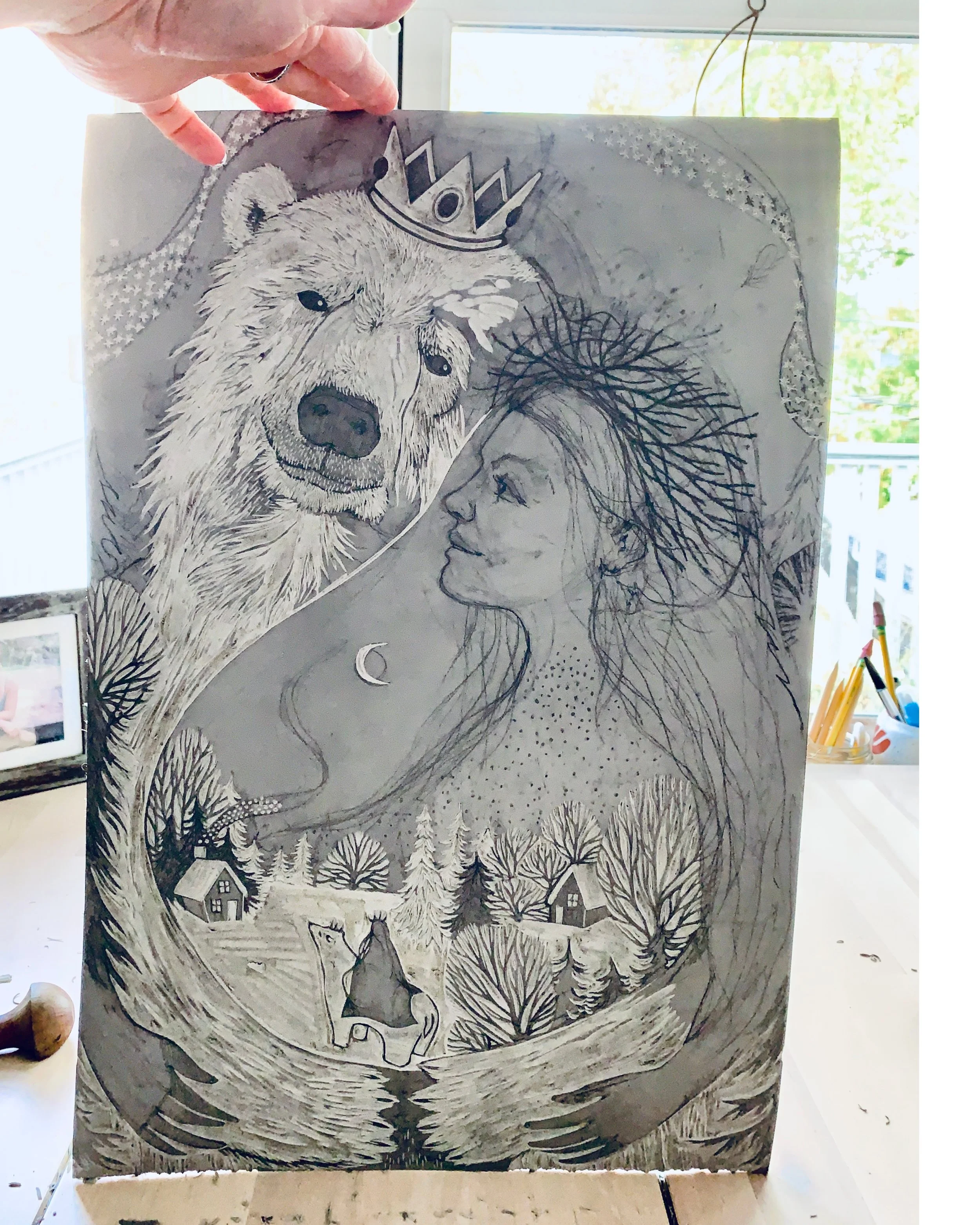
In the midst of carving a design inspired by East of the Sun and West of the Moon
Bear also is evoked in stories of growth, initiation and transformation. In the ancient Norwegian folktale East of the Sun, West of the Moon, a young woman is betrothed to Bear whom she discovers is a human prince under a wicked spell. She undergoes a perilous journey to save him, and in the end she discovers her own power, resolve, courage and resilience. Once more, here we find a story about how a relationship with Bear is initiatory and transformative for the human woman. Bear helps motivate her to undergo the hardship she needed to experience to discover her true strength, he is deeply integral to her own becoming.
In these traditions, Bear stands at the threshold where old identities all away and new ones manifest. Bear holds the liminal ground where girls step into womanhood, where womanhood ripens toward motherhood, and where a young woman encounters the depth of her own strength for the first time. To meet Bear here is to be guided through uncertainty, fear, rather than spared from it, to discover that becoming is not a clean departure but a threshold journey—entered, endured, and emerged from under Bear’s attentive gaze.
The Shamanic Bear: Mediator Between Worlds
Some thresholds do not belong to age or season, but to the unseen corridors between worlds. Here, Bear appears again—this time as guide, teacher, and companion on spiritual journeys the human soul cannot make alone.
Among many Indigenous Siberian peoples — including the Evenki, Evens, Khanty, Mansi, Nivkh, and Nanai — Bear is one of the most sacred and powerful animal presences in shamanic cosmology. Its is Bear who taught the first human shaman how to heal, the rhythms of trance, and ritual song, helping to mediate in their journeys between worlds. Bear does not stand separate from the human shaman; she rises in the shaman’s den, pulses in the the shaman’s heartbeat, waits in the dark spaces where human and spirit meet. Shamans do not simply honor her—they become Bear, wearing her hides, carrying her claws, letting her strength flow through their own flesh. Among the Ket, she walks with some shamans as ancestral spirit and companion, and in Buryat lands, Bear is more powerful than any human shaman, more powerful, more ancient, a primordial guide whose authority cannot be contested. Bear does not lend power—she insists on it, and those who follow her learn to cross the worlds as she does: awake, watchful, and alive.
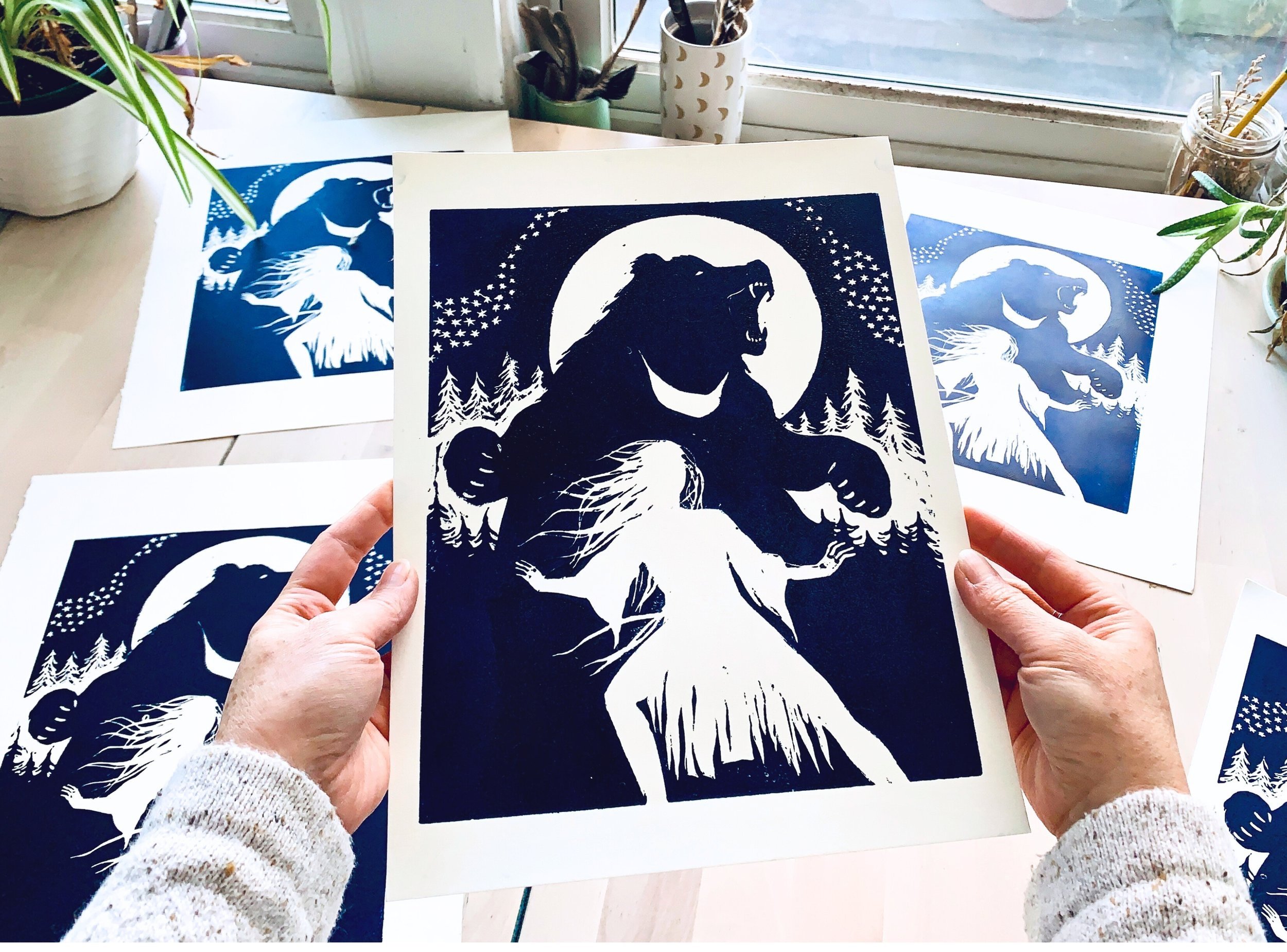
Inspired by the Ainu folktale of Crescent Moon Bear
Sámi cosmology places Bear (Guovža) among the most spiritually powerful beings. In some Sámi traditions, shamans trace their spiritual lineage to Bear, and Bear ceremonies involve ritual speech, drumming, and careful reintegration of Bear’s spirit after death. Bear is seen as a cosmic mediator, whose spirit could carry prayers and restore harmony. Bear is believed to understand human language, possess a soul equal to a human’s, and travel freely between worlds.
In the Ainu tale of the Crescent Moon Bear, a woman seeks help when her husband returns from war altered beyond recognition. The shaman sends her not to cure, but to cross. She must retrieve a whisker from the Crescent Moon Bear, a task that demands courage and risks her life. When the whisker is discarded, the teaching is revealed: the medicine was never the object, but the strength she forged in the crossing. Bear and shaman blur into one another. Transformation happens not through intervention, but through ordeal held in relationship.
Across cultures, Bear appears wherever humans must traverse the unseen. Neither fully animal nor fully human, Bear’s liminal nature becomes her gift. She teaches how to enter the in-between, how to listen there, and how to return bearing insight rather than fracture.
Bear Walks with Us Through Loss, Rebirth, and Renewal
Again and again, when humans feel the hollow ache of absence, Bear is there as confidant, supporter, warm comfort through the grief and loss.
In In The Bear’s House, Pulitzer Prize–winning author N. Scott Momaday draws on his own Kiowa heritage to tell of a boy who transforms into a bear. He chases his sisters to a tree, from which they ascend into the heavens as the stars of the Big Dipper. Though their individual names are lost, they endure collectively, held safely by Bear’s presence. Later, the boy-bear approaches a hunter on his hind legs, speaking in a human voice and acknowledging kinship across the threshold. Here, Bear appears at the moment of the sister’s ascendance to the heavens, appearing later to a hunter who knew the girls, as a companion through the shadowed passage of mourning, a den that gathers the tremors of grief and teaches the psyche how to endure and emerge renewed.
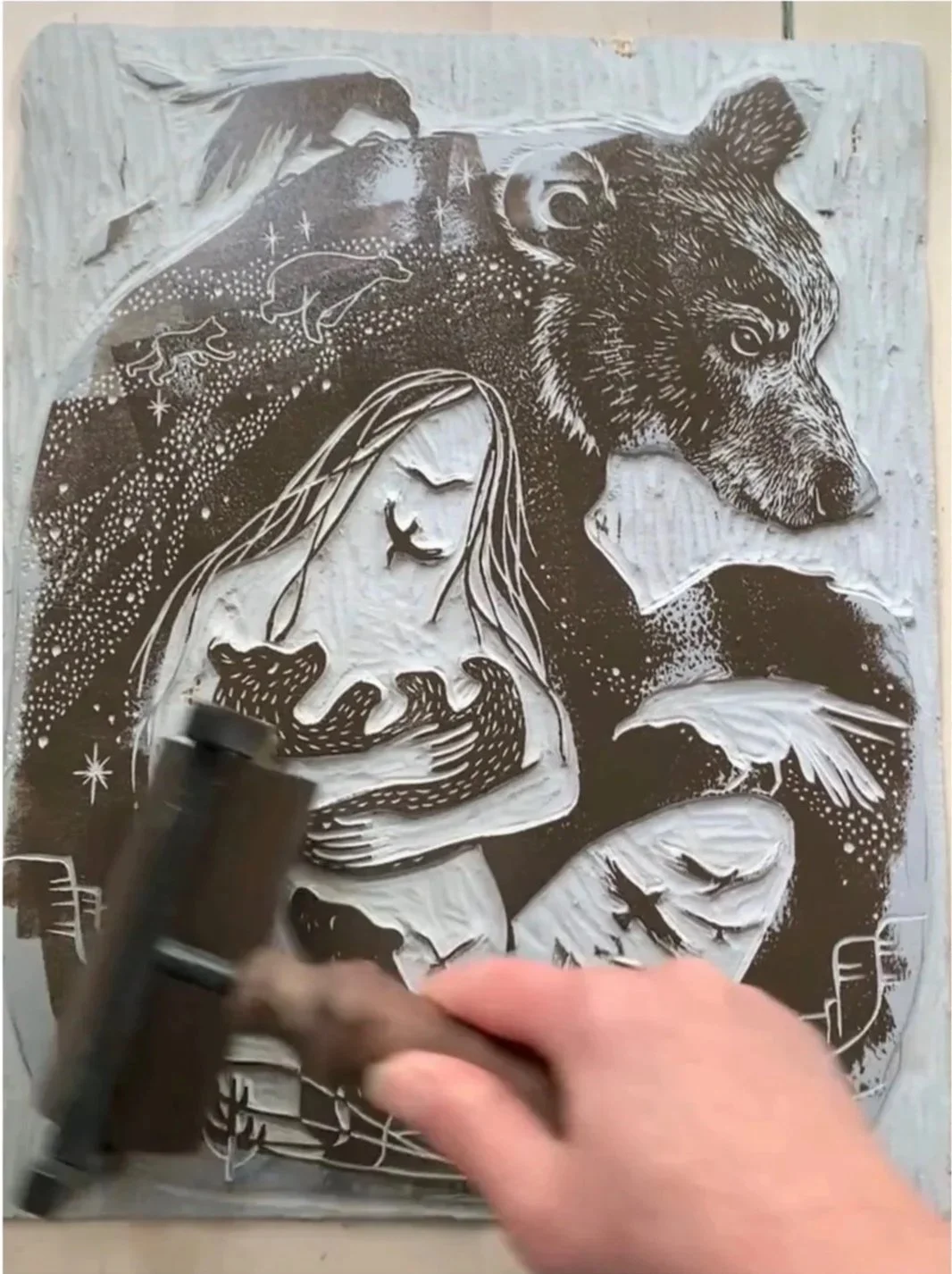
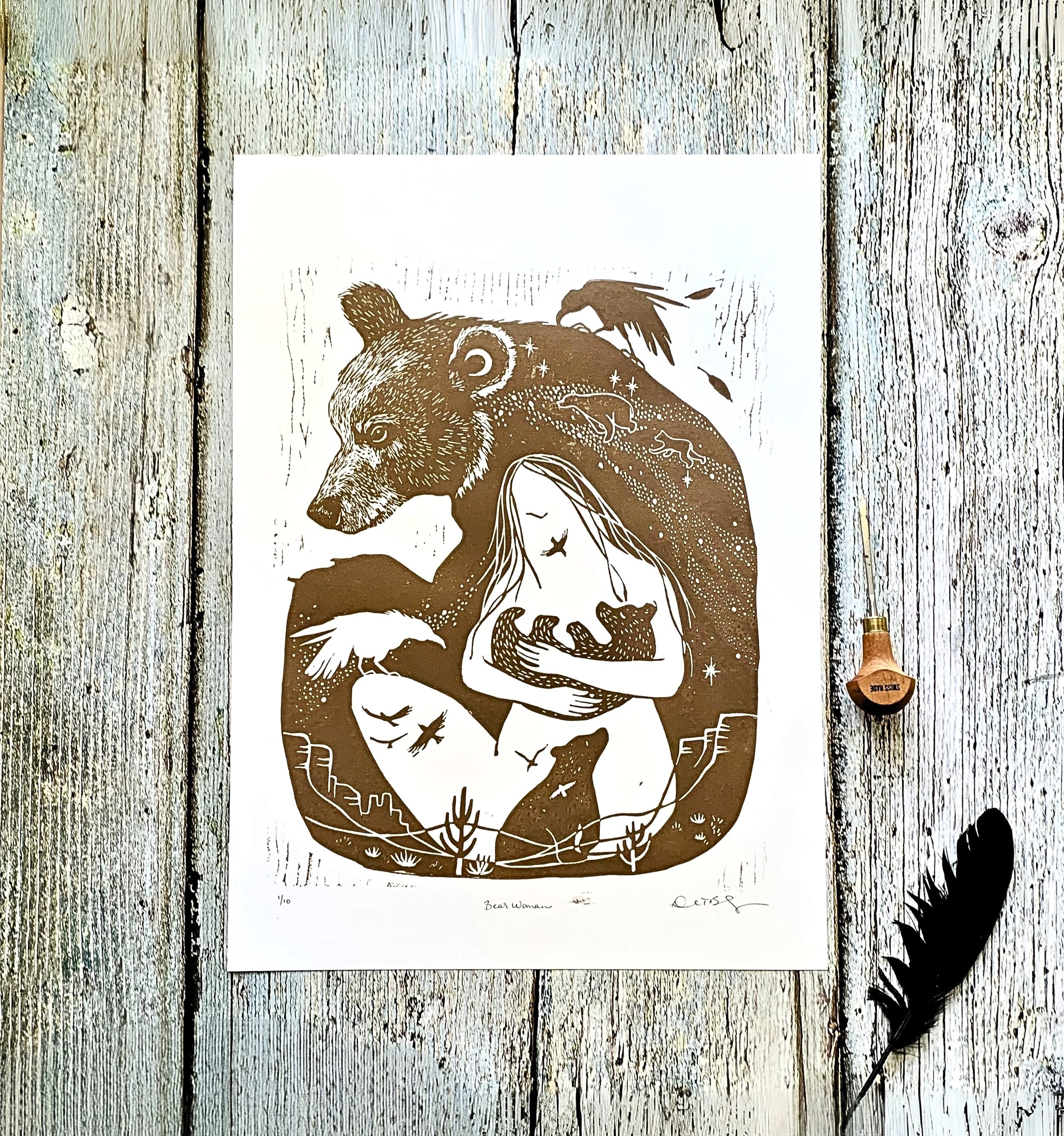
Inspired by Sonja Grace’s retelling of a Hopi folktale of Bear who guides a woman during her time of loss in her book Dancing with Bear and Raven.
Among the Hopi, as recounted by Sonja Grace in Dancing with Bear and Raven, Bear and Raven act as companions in the journey between worlds. When a woman dies unexpectedly, leaving two children behind, Bear walks beside her, offering introspection, endurance, and gentle guidance. In this story, Bear mediates the crossing from one existence to another, providing quiet strength and tender presence in moments of profound loss.
In Norse tradition, warriors called berserkers summon the bear’s spirit in moments of mortal trial. Draped in Bear’s pelt, they step into battle, calling on Bear’s strength, courage, and ferocity. Sacred to Odin, Bear transforms them from ordinary humans into beings capable of facing chaos and danger, guiding them across the threshold between fear and action, life and death. Here, Bear is invoked when human power alone cannot suffice, acting as a more-than-human guardian, fortifying the spirit and body alike.
In these examples, Bear serves as a bridge through thresholds of loss, grief or impending potential death. Whether carrying humans to the heavens, guiding the bereaved between worlds, or emboldening warriors, Bear stands at the liminal edge—patient, vigilant, and potent. In the presence of Bear, the uncertain space between endings and beginnings is held with care, and transformation becomes possible.
Bear and Healing
Beneath the wide desert skies of the American Southwest, Bear is a medicine keeper and is named Osa, named after the wild root osha—often called “bear root” or “bear medicine”—because when spring returns, Bear is known to seek it out. She chews it, rolls in it, rubs it into her fur—using it as a cleansing, awakening ritual. Even the male Bear has been seen using the root as a love potion, perfuming himself with it in a gesture as old as courtship itself. A wild cousin of lovage, and a sacred plant, osha grows throughout the Southwest and Rocky Mountains and is revered for both medicinal and ceremonial uses, particularly among the Apache, Pueblo, Navajo, Zuni, White Mountain Apache, Southern Ute, Lakota, and the Tarahumara of northern Mexico. Osha’s wisdom is timeless and enduring as living medicine—part of a long and tender conversation between land, animal, and human.
Bear’s medicine is mirrored in story. In the Southwestern folktale Tres Osas or The Three Bears, beautifully retold by Dr Clarissa Pinkola Estes in her audiobook The Dangerous Old Woman, three elderly Curanderas (herbal, ritual healers who are also weavers) come to the aid of a young woman, who is tasked by a cruel father to spin a whole room of straw into gold overnight. It is a demand meant to break her, to keep her trapped, but three Curanderas arrive, bearing both magic and the marks of her devotion: a flattened thumb, a splayed foot, a drooping lip. They agree to help her spin the straw, asking only one thing in return: that she remember them, that she invite them to her wedding, and the young woman agrees.
The work is completed and true to her promise, when the Curanderas return on the eve of the young woman’s wedding, it is not to claim reward, but to witness what the healing has set in motion. Yet the bridegroom, startled by the Curanderas’ weathered faces and altered bodies, recoils in judgment and refuses to marry. Three times on his journey away, he chooses danger over safety and each time one of the Curanderas appears, steadfastly guiding him back across the threshold he cannot yet cross alone. They see what is wounded in him, where his misaligned choices would cost him love, and they don’t rescue, but through their steady presence, his fear loosens, his scorn softens, and something in him is rewoven. By the journey’s end, he has changed—able now to approach the young woman for a second time with humility to ask for her hand in marriage. This time, the Curanderas attend the wedding as guests of honor and after they return to the forest, transforming back into the bears they always were.
Here, Bear emerges as a trio of weavers, creaturely heroines, who appear when the threads of life begin to unravel, and remains present as a witness to the loosening, the tangle, until a new pattern is woven. Here, the psyche rests within Bear’s loom, where She weaves the broken and the becoming into a single living thread—survival, kinship, continuity. Though this story is North American, it is echoed in a Germanic Grimm fairytale The Three Spinners. . .both stories remember a shared Truth: weaving is a form of medicine.
Osha, or Bear Medicine, is the art of joining what has been separated—of finding medicine in the land, of weaving something whole enough to endure. Healing, like Bear, is a woven den, where what has been broken is not abandoned, but carefully threaded back into belonging.
In Bear’s Den
Bear is present in the stories cultures tell to make meaning of life’s transitions: weaving together the person we once were with the person we are becoming; stitching together the country of our former selves to the new landscapes of belonging; threading together the old ways of seeing into the ways now taking hold; and interlacing the stories we lived by with the stories now asking to be lived. At the heart of these stories, in Bear’s presence, even the most harrowing passages reveal themselves as something else entirely: not only rupture, but refuge; crossings are not only endured but held; transition is not abandonment but attendance; relational rather than isolating. The transformation becomes a hallowed den, a sheltering center of tending rather than abandonment - relational, watchful, alive - where psyche and nature, creature and cosmos curl together as one and where the many threads of a former life are gathered, rewoven, birthed, and nursed into the next season or chapter of life.
This truth invites a larger question: if Bear has long helped humans navigate personal thresholds, might her presence also accompany us through the great unraveling of our own time? We often treat Bear myths and legends as remnants of Deep Time, as though they belong to a vanished world, forgetting that they were once spoken by ordinary people standing in the living present, trying to make sense of change, loss, and renewal. In the quiet spell that storytelling uncovers, the differences we now inscribe through nations and borders are revealed as brief modern interruptions in a much more ancient interweaving of humans and bears in Deep Time. We begin to discover the real map of belonging isn’t drawn in lines at all, but in our shared kinship with bear that whisper through time beneath the paw prints in the snow. . .Perhaps Bear’s enduring resonance—across cultures and centuries—points to something more palpable and present tense than a mythological being only existing among the ancients or today’s indigenous cultures. Bear has never belonged only to the past. She moves toward the places of becoming. She follows the ache, the uncertainty, anxiety that accompanies the crossing. When we open ourselves to Bear’s return, welcome Her into the present— She endures, not as a myth remembered, but as a presence alive, curled up beside us as She always has been, through every turning. In today’s fractured world, where truths are unraveling, norms are changing, and uncertain futures present themselves, Bear might be precisely the companion we need to collectively turn to hold us as we pass through the portals of unknowing that transformation demands. We must trust that the story of the She-Bear – pregnant still with meanings we have yet to uncover – can offer us her warm den and it is She who will keep watch over us as we witness the loosening of identities, systems and narratives that no longer hold. She can help us carry the weight of endings together.
Bear’s role as threshold keeper reveals not only how many of our ancestries are interwoven through shared bear folklore once circling the northern boreal regions, but also what has been lost. The very presence of Bear across these traditions points toward a collective shadow: the long process by which these connections were severed. War, colonialism, imperial ambition, and the hatreds that raise walls between peoples have frayed what was once held in common. To explore the shared folklore and history of Bear across cultures—and to recognize how her role as a threshold guardian and nurturer resonates widely—is to confront the rupture that has separated these connections. It asks us to reckon with how we arrived at a present in which these shared inheritances are no longer readily known, buried beneath histories that tell separate and competing stories of nationhood—stories shaped by conflict and rivalry rather than by the deeper, collective truths they once shared. Turning toward the unexamined shadow of our past—and allowing ourselves to grieve its wounds—is how Bear heals. Bear is Osa, healer. The work She asks of us is a descent: a return to the dark den, the hallowed space where psyche and nature, creature and cosmos curl together as one—where the many threads of a former world are quietly grieved, rewoven, held in darkness, birthed, and nursed as the next world begins. In this grieving and loss, the structures that once defined us—our identities, paradigms, inherited truths, and beliefs—may begin to loosen and unravel. Yet we are not abandoned. Curled beside Bear in her den, we are held through the unmaking. And perhaps, in the fragile terrain between what is falling away and what has yet to be born, She nurses us as a collective, and a new world begins to take shape—one that carries new threads of rootedness, new currents of truth, and a quiet tender aliveness.
This is Bear’s true enchantment—Her medicine and mothering, and her fierce, enduring power.
End Note on Resonance
I want to name my intention in speaking across traditions. I am not suggesting that mythic stories from disparate cultures are identical or interchangeable, nor that shared motifs imply shared meanings. The symbol of Bear does not carry the same significance in every culture; ritual, cosmology, and relationship differ across Indigenous lifeways, Scandinavian lore, Ainu practice, and beyond. Each story arises from its own rooted context—shaped by particular landscapes, histories, languages, and ways of knowing. What I am attending to here, with humility and care, are resonances: moments where distinct traditions independently offer wisdom for human experience at times of transition, loss, and becoming. These resonances do not erase difference. Rather, they illuminate relational possibilities, reminding us that across great distances and deep cultural specificity, humans have long turned to story to orient themselves at the thresholds of life. My stance is not one of collapse or comparison, but of relation—an offering meant to deepen empathy across borders, and to suggest that sometimes, something in us recognizes something in another without needing to claim it as our own.
References:
Archive for Research in Archetypal Symbolism (ARAS). The Book of Symbols: Reflections on Archetypal Images. Taschen, 2010.
Estés, Clarissa Pinkola. The Dangerous Old Woman: Myths and Stories of the Wise Woman Archetype. Sounds True, 2010.
Estés, Clarissa Pinkola. (1996). Women Who Run With the Wolves: Myths and Stories of the Wild Woman Archetype. Ballantine Books
Grace, Sonja. Dancing with Raven and Bear: A Book of Earth Medicine and Animal Magic. Findhorn Press, 2018
Janhunen, Juha. “Tracing the Bear Myth in Northeast Asia.” Acta Slavica Iaponica, vol. 20, 2003, pp. 1–24. Slavic-Eurasian Research Center, Hokkaido University.
LaPier, Rosalyn R. “How a Ojibwe Coming‑of‑Age Ritual Is Making a Comeback.” Boreal Community Media, 13 Feb. 2020, boreal.org/2020/02/13/296873/how-a-ojibwe-coming-of-age-ritual-is-making-a-comeback. Accessed 11 Dec. 2025.
Moerman, Daniel E. Native American Ethnobotany. Timber Press, 1998.
Momaday, N. Scott. In the Bear’s House. University of New Mexico Press, 2011.
Shepard, Paul, and Barry Sanders. The Sacred Paw: The Bear in Nature, Myth, and Literature. Viking, 1985.
(Podcast) “Bear Culture: Scandinavian bear folklore with Olle Möllervärn.” Fair Folk Podcast, episode by Fair Folk, 11 Apr. 2023.
Wozniak, Edward. "Twenty Vietnamese Gods and Goddesses". Balladeer's Blog, 2020.
Leeming, D. (2005). The Oxford Companion to World Mythology. Spain: Oxford University Press, USA. 394-395.
Asian Mythologies. (1993). United Kingdom: University of Chicago Press. 225-226.
Yamada, Takako. “The Ainu Bear Ceremony and the Logic behind Hunting the Deified Bear.” Journal of Northern Studies, vol. 12, no. 1, 2018, pp. 35–51, doi:10.36368/jns.v12i1.898
More bear blog posts


How do we live with the parts of ourselves that pull in opposite directions—the ache between duty and desire, safety and freedom, comfort and becoming? Myth doesn’t give us neat answers, but offers meaning, metaphor, and creative possibilities . . . Woven into the heartbeat of Celtic horse goddess myths is a lesson on how to live within paradox. Celtic horse goddesses don’t flee contradiction—they ride it—reminding us that wholeness isn’t found in resolution, but claiming power within the pull: imperfect, and beautifully whole.